
Cement is the cornerstone of modern construction and a key ingredient in building materials like concrete and mortar. Here’s something most people don’t realize: you can change furniture or paint in your home anytime you want, but never the cement. The type you choose affects your home’s strength permanently – there’s no going back.
Understanding what different types of cement are available matters more than most builders realize. This choice impacts everything from how long your structure lasts to whether it can handle the specific conditions it faces. This guide walks through 15 types of cement for construction, their real-world applications, and what you actually need to consider when choosing cement with Kamdhenu Cement, the best cement for house construction.
Kamdhenu Cement: India’s Trusted Cement Brand
India has several reputable cement brands, each playing important roles in the country’s construction landscape. But Kamdhenu Cement stands out as the no 1 cement in India for good reasons – unwavering commitment to quality and customer satisfaction being chief among them.
The company places strong emphasis on innovation and technological advancements. Kamdhenu Cement uses state-of-the-art manufacturing processes and stringent quality control measures that ensure consistently high-quality cement meeting demanding construction standards. And their focus goes beyond just making good products – it extends to excellent customer service, reliable delivery, and a strong distributor network that covers the entire country.
When you choose Kamdhenu Cement, you’re choosing confidence. Builders and contractors know they can trust the strength, durability, and reliability this brand brings to their construction projects.
15 Types of Cement and Their Uses
Understanding different types of cement helps you select the right material. Here are the types of cement grades and their ideal applications:
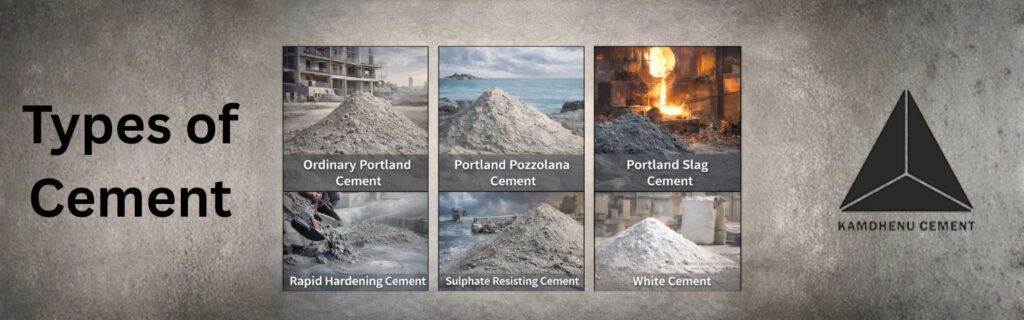
- Ordinary Portland Cement (OPC) The most common cement type used in construction for residential and commercial buildings, bridges, and roads. It offers a good balance of strength and setting time, making it versatile for general construction work. OPC is your go-to choice for most construction projects.
- Portland Pozzolana Cement (PPC) Made by blending Portland cement with pozzolanic materials like fly ash. Known for excellent workability, durability, and sulfate attack resistance. PPC is often used in marine structures and areas with aggressive soil conditions. The pozzolanic materials improve long-term strength and reduce permeability significantly.
- Portland Slag Cement Blends Portland cement clinker with ground granulated blast furnace slag, a steel industry byproduct. Offers excellent durability, sulfate resistance, and reduced heat of hydration. Suitable for mass concrete structures like dams and large foundations where heat management matters.
- Rapid Hardening Cement Sets and gains strength much faster than OPC. Ideal when rapid construction is required – emergency repairs, precast concrete production, or cold weather construction where early strength is critical. Has higher early strength allowing faster project completion.
- Low Heat Cement Generates less heat during hydration. Made by reducing tricalcium aluminate content. Suitable for massive concrete structures like dams, bridges, and large foundations where excessive heat causes cracking. The slower heat release prevents thermal stress.
- Sulphate Resisting Cement Specifically designed to resist harmful sulfate effects causing concrete deterioration. Commonly used in marine structures, sewer lines, coastal areas, mines, and applications exposed to sulfate-rich environments or groundwater.
- White Cement Manufactured using high-purity raw materials, resulting in white or off-white color. Has a high degree of whiteness. Primarily used for decorative purposes – architectural concrete, sculptures, decorative finishes, terrazzo flooring, and aesthetic applications where appearance matters.
- Colored Cement Pigments (5-10%) are added producing various colors like red, green, yellow, and brown. Used for decorative purposes creating aesthetically pleasing concrete surfaces in parks, pathways, countertops, flooring, and architectural features. Enhances aesthetic appeal giving projects unique looks.
- Expansive Cement Expands slightly after setting, helping compensate for shrinkage and reducing cracking risk. Used in precast concrete elements, grouting applications, and where controlled expansion is required like grouting anchor bolts or filling voids.
- Oil Well Cement Specialized cement designed to withstand high temperatures and pressures encountered in oil and gas well drilling operations. Maintains strength and integrity under extreme conditions found deep underground.
- Masonry Cement Specifically formulated for mortar used in laying bricks, blocks, and masonry units. Offers good workability, adhesion, and water retention properties ideal for masonry work.
- Waterproof Cement Contains additives improving water resistance. Commonly used where waterproofing is critical – basements, bathrooms, swimming pools, water storage tanks, and sewage treatment plants requiring moisture protection.
- High Alumina Cement Made by melting and grinding bauxite and lime together. Sets and gains strength rapidly at high temperatures. Used in refractory applications like furnace linings, fire-resistant concrete, chemical plants, and kilns where resistance to high temperatures and corrosive chemicals is essential.
- Geopolymer Cement Environmentally friendly alternative to traditional Portland cement. Made from industrial byproducts like fly ash and slag, significantly reducing construction’s environmental impact. Suitable for sustainability-focused projects and green buildings.
- Self-Compacting Concrete (SCC) High-performance concrete flowing easily into formwork without vibration. Contains air-entraining agents creating microscopic air bubbles. Improves workability, reduces labor costs, and requires less water than ordinary cement.
Types of Cement Grades: Choosing the Right Strength
The grade of cement you choose determines your home’s strength and durability. It’s important to choose the right types of cement grades according to needs, not just cost savings. Because it’s a choice you get only one chance to make, choose what’s best for the structure.
Cement grades refer to compressive strength after 28 days of curing, measured in N/mm². The most commonly used grades in India are 33, 43, and 53, each serving different construction needs.
33 Grade Cement The most basic type used for general construction and plastering work.
- Strength: 33 N/mm²
- Application: Suitable for non-critical strength projects, not for concrete mix above M20
43 Grade Cement The go-to cement for most home construction needs in India, offering balance of strength and cost.
- Strength: 43 N/mm²
- Application: Used for plain concrete, plaster, precast items like tiles. Suitable for concrete mix up to M30.
53 Grade Cement For projects demanding superior strength, this is the best option.
- Strength: 53 N/mm²
- Application: Best for high-rise buildings, dams, heavy-duty structures. Suitable for concrete mixes above M25.
Note: Higher grades generate increased heat during hydration, requiring careful management preventing cracking. Always match cement grade with construction requirements following recommended mixing and curing practices.
Price of Cement in India – What Really Affects It?
Before buying cement for your project, it is important to understand that prices are not fixed. Even for trusted brands like Kamdhenu Cement, the final price depends on a few practical, on-ground factors.
Here is a short and clear table explaining what mainly affects cement prices:
| Factor | How it Affects the Price |
| Type of Cement | Special variants (e.g., rapid hardening, sulphate-resisting, or white cement) carry a premium over standard OPC or PPC. |
| Cement Grade | Higher grades (43 or 53) typically cost more due to their superior compressive strength and performance specs. |
| Location & Logistics | Proximity is key; costs scale upward the further a site is from the manufacturing plant or distribution hub. |
| Order Quantity | Economies of scale apply here. Bulk industrial orders usually see significant discounts compared to retail “bag” prices. |
| Packaging & Handling | Branded packaging and specialized moisture-proof bags, along with manual labor for unloading, add to the unit cost. |
| Market Demand | Prices fluctuate seasonally; expect higher rates during peak dry seasons when construction activity surges. |
In short:
The price of cement mainly depends on type, grade, location and quantity.
Instead of choosing only the cheapest option, always match the cement type and grade with your construction needs to avoid long-term problems.
Measuring Cement Quality
Ensuring cement quality is paramount for construction project strength and durability.
Compressive Strength – Measures cement’s ability to withstand compressive loads. Higher strength ensures stronger, more robust structures. Standardized tests determine compressive strength at 3, 7, and 28 days.
Fineness – Refers to particle size distribution. Finer cement particles offer larger surface area for hydration, leading to faster strength development and improved workability, resulting in more uniform concrete mix.
Setting Time – Crucial for efficient construction. Initial setting time determines time available for placing and finishing concrete. Final setting time determines when concrete can be subjected to further loads.
Soundness – Ability to maintain volume and shape after setting. Unsound cement may undergo expansion or contraction, leading to cracking and distortion. Typically evaluated through the Le Chatelier test.
Chemical Composition – Presence of specific compounds like tricalcium silicate (C3S), dicalcium silicate (C2S), tricalcium aluminate (C3A), and tetracalcium aluminate ferrite (C4AF) significantly influences strength, setting time, and other properties.
Choosing the Right Cement
Selecting the right cement type is crucial for construction project success. Consider these factors:
Application – The specific application determines required properties like strength, durability, and resistance to specific conditions.
Budget – Cement price varies depending on type and brand. However, don’t compromise quality for cost savings.
Availability – Ensure chosen cement type is readily available in your region.
Environmental Considerations – Choose environmentally friendly options like geopolymer cement whenever possible for sustainable construction.
Conclusion
Selecting the right types of cement is crucial for any construction project’s success. By carefully considering factors like specific application, budget, availability, and environmental impact, you make informed decisions choosing the best cement for your needs.
Reputable brands like Kamdhenu Cement, known for commitment to quality and customer satisfaction, play vital roles in ensuring strength, durability, and longevity of construction projects. Understanding different types of cement and their uses helps you select materials perfectly suited to your specific requirements.
By choosing high-quality cement and adhering to best construction practices, you build structures that are strong, durable, safe, and sustainable for generations. Remember, you get only one chance to choose the right cement – make it count with Kamdhenu Cement, India’s trusted partner in construction excellence.