
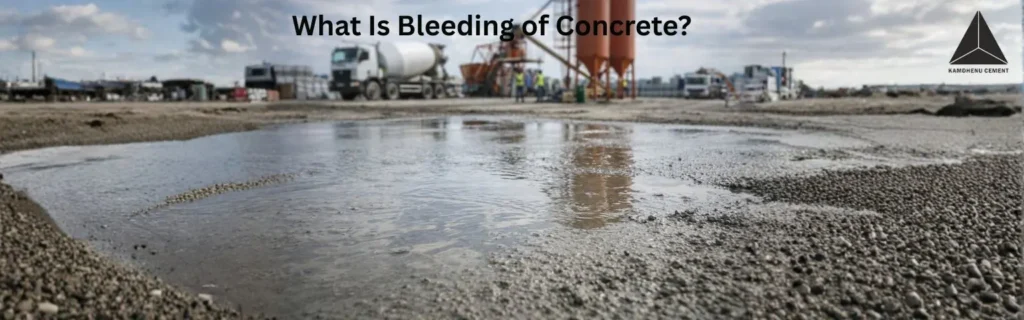
Imagine this: you have just poured concrete to the foundation of your new home. Everything looks perfect. However, after several minutes, you see water coming to the surface forming a glossy wet surface. That’s bleeding.
Bleeding of concrete occurs when the water in the concrete mix flows upwards and accumulates on the surface. Imagine it in the following way- concrete is a blend of cement, sand, stones, and water. The cement, sand, and stones are heavier and thus they naturally settle down. Water is less dense and thus it is pushed up.
A small amount of bleeding is normal. However, when excess water starts to rise, it causes severe issues. The surface becomes weak and is likely to crack and does not last as long as it is supposed to.
Then what is bleeding of concrete in plain English? It’s excess water escaping to the surface while the solid materials sink down. The trick is to understand when it is normal and when it is excessive.
Causes of Bleeding of Concrete
What is the cause of bleeding of concrete? Here are the main reasons:
Too Much Water in the Mix – This is the largest reason. When you pour in excess water, the concrete will not absorb all the water. The additional water has no place to go but up. Most individuals pour more water to make concrete easier to handle, yet this backfires.
Incorrect Water-Cement Ratio – Each concrete blend requires the appropriate proportion. When there is excess water relative to cement, bleeding is more. The perfect proportion holds it all together.
Poor Quality Aggregates – The sand and stones should be mixed or graded well otherwise they cannot retain water. The water flows through the holes and comes to the surface.
Not Enough Cement – Cement is a glue in concrete. When the cement in the mix is insufficient, there is insufficient glue to hold the water in place so that it does not escape upwards.
Over-Vibration – Vibrating concrete eliminates air bubbles and strengthens it. However, excessive vibration causes water to be thrown out of the mix. The vibration causes the solid particles to move downwards and water to move upwards.
Poor Mixing – When concrete is not mixed correctly, the components do not mix evenly. The wet sections will be more bleeding.
Hot Weather Conditions – Hot weather with low humidity accelerates the evaporation on the surface. This draws water upwards more quickly. This is also accelerated by wind.
Application of Certain Types of Cement – There are certain types of cement that inherently result in more bleeding due to their chemical makeup.
Effects of Bleeding of Concrete
When bleeding of concrete gets out of control, here’s what happens:
Weak Surface Layer – As water ascends, it forms a weak layer on the surface known as laitance. This layer is so feeble that you can peel it off with your fingernail. Any edifice erected on this will not stand.
Cracks Everywhere – Once the bleed water is evaporated, it leaves behind empty spaces. These are the weak points that make the surface crack as the concrete dries and shrinks.
Reduced Overall Strength – The rising water dilutes the cement on the surface. Less cement translates to less strength. The entire structure is made weaker than it is supposed to be.
Increased Porosity – Water that flows up forms small holes in the concrete. When it evaporates, these channels are left behind, and your concrete is porous as a sponge. This enables additional water to percolate later.
Poor Bond with Reinforcement – Water gathers under steel bars (rebars) within the concrete. This leaves a void between the concrete and the steel, which makes the bond weak. The reinforcement is unable to perform its duty.
Surface Defects – Bleeding results in honeycombing (holes resembling a honeycomb), irregular texture, discoloration, and roughness. These are not merely ugly, but they are signs of more serious issues.
Increased Setting Time – The watery surface is much slower to harden. This postpones your construction schedule.
Segregation and Bleeding of Concrete – Key Differences
People often confuse segregation and bleeding of concrete, but they’re different. Here’s a simple comparison:
| Aspect | Bleeding | Segregation |
| Definition | Only water separates and rises to the surface. | All ingredients (cement, sand, stones, water) separate from each other. |
| Timing | Occurs after pouring, while the concrete is settling. | Occurs during mixing, transporting, or the actual pouring process. |
| Visual Cues | Water puddles or a “shiny” film on the top surface. | Honeycombing, stones at the bottom, or mortar paste at the top. |
| Primary Cause | Excessive water-to-cement ratio (too much water). | Improper handling, over-vibration, or poor mix design. |
| Classification | A specific, localized form of segregation. | A broad term for the total breakdown of the mix. |
| Final Impact | Creates a weak, porous, and “dusty” top surface. | Leads to uneven strength, voids, and structural instability. |
The easy rule to keep in mind: Bleeding is when only water comes out on the top. Segregation is the separation of all things and their going to other places.
Segregation and bleeding of concrete lead to weak concrete, but bleeding is the separation of water. You may have segregation without bleeding, but bleeding is never but a form of segregation.
How to Prevent Bleeding of Concrete?
Good news- bleeding of concrete can be avoided. Here’s what works:
Manage the Water-Cement Ratio – Only the necessary amount of water should be used. Keep the ratio to the recommended (typically 0.40 to 0.50). Do not pour in more water to make concrete easier to handle.
Use Well-Graded Aggregates – Select sand and stones of good mixture of sizes. When particles of varying sizes are mixed, they become compact and do not allow water to escape easily.
Add Chemical Admixtures – Water-reducing admixtures (plasticizers) are used to render concrete workable without the addition of additional water. Admixtures that are specifically aimed at reducing bleeding are also available.
Use Air-Entraining Agents – These form small air bubbles that trap water. This also enhances the resistance of the concrete to freezing.
Don’t Over-Vibrate – Vibrate only to the extent of eliminating air pockets and settling the concrete. Stop when the surface is smooth. Bleeding occurs when continued past this.
Wait Before Finishing – This is essential. Do not begin troweling when bleed water appears. Allow the water to evaporate. When you work the surface with water on it, you will trap the water in the upper layer, forming a weak surface that will peel off later.
In most cases, it is sufficient to wait 20-30 minutes. Patience–this spares you years of trouble.
Control Environmental Conditions – It is advisable not to pour concrete during very hot, dry or windy weather. Windbreaks, shade, or misting to slow down evaporation, should be used, if necessary.
Choose the Right Cement Type – Some cement types are less prone to bleeding. Consult with experts about which cement works best for your conditions.
Proper Compaction – Compact the concrete correctly to remove air voids and ensure even distribution. But don’t overdo it.
Increase Fine Aggregate Content – Adding more fine sand helps absorb excess water. Fine particles have more surface area to hold water.
READ MORE- Ready mix concrete , OPC vs PPC vs PSC
Conclusion
It is important to understand the phenomenon of concrete bleeding if you are planning to build a house or are involved in a construction project. It is not merely a technical term; it is a matter of ensuring that your building remains strong for many years to come. Bleeding occurs when there is too much water rising to the top, making the surface weak and vulnerable to cracks. This is normally due to excess water being added to the mixture or over-vibrating the concrete mixture.
The best part is that you can prevent this from occurring easily. If you maintain a strict water-cement ratio, use quality materials, and allow the surface water to evaporate before completing the construction, you will be able to avoid costly repairs down the line. Selecting a quality brand such as Kamdhenu Cement is the key to laying a solid foundation for a strong and reliable construction project. Do not let a small mistake in the mixture jeopardize all your hard work.