
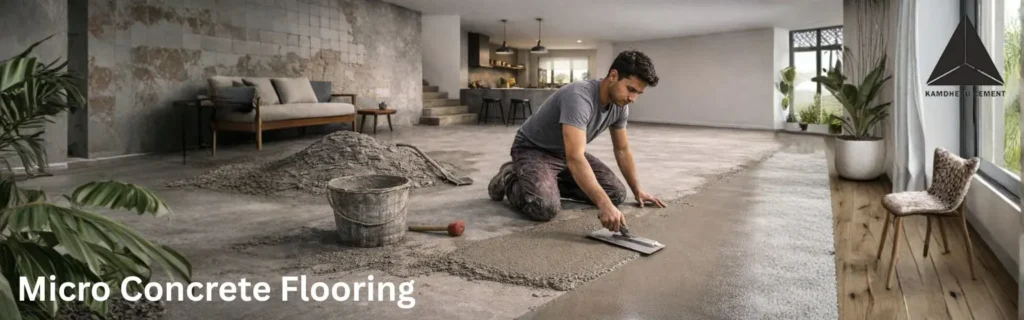
Ever walked into a modern home or upscale café and noticed those sleek, seamless floors that look like polished concrete? You were likely looking at micro concrete flooring – one of the hottest trends in modern interior design.
Micro concrete flooring (also called microcement) is a thin, cement-based coating applied to existing surfaces to create a smooth, continuous finish. Unlike traditional concrete floor systems that require thick pours, micro concrete goes on in layers as thin as 2-3mm, transforming tired old floors into stunning, contemporary surfaces.
What makes this cement concrete flooring special? You can apply it over tiles without removing them, coat walls and floors seamlessly, or create custom countertops that look like solid concrete but weigh much less.
Micro concrete flooring offers practical benefits – it’s waterproof, stain-resistant, durable, and requires minimal maintenance. Hotels, restaurants, homes, and swimming pools are switching to this innovative concrete floor solution.
The quality of your micro concrete flooring depends on the concrete floor mix ratio and cement quality you use. Get these right with quality cement like Kamdhenu Cement, and you’re looking at a floor that serves beautifully for decades.
Micro Concrete vs Regular Concrete Floor
Let’s clear up the confusion. Many people think micro concrete is just “thin regular concrete,” but that’s not accurate.
Regular Concrete Floor is what you typically see in driveways and building foundations. It’s a thick mixture (usually 50mm to 100mm+) of cement, sand, coarse aggregates (gravel), and water. The concrete floor mix ratio for regular concrete typically follows 1:2:4 (1 part cement, 2 parts sand, 4 parts coarse aggregate). It’s designed for strength and load-bearing capacity, not aesthetics.
Micro Concrete Flooring is a decorative coating made from very fine cement particles, polymers, resins, and specially graded fine aggregates. No coarse gravel – everything is fine enough to create that smooth, polished finish.
This cement concrete flooring goes on incredibly thin – just 2mm to 3mm total thickness – which is why it can overlay existing surfaces. Imagine applying this over old tiles, marble, or worn concrete without demolition. That’s the magic of micro concrete.
Key Differences:
- Thickness: Regular concrete = 50mm+. Micro concrete = 2-3mm
- Purpose: Regular concrete = Structural support. Micro concrete = Decorative finish
- Application: Regular concrete = Poured fresh. Micro concrete = Troweled over existing surfaces
- Weight: Regular concrete = Very heavy. Micro concrete = Lightweight
- Versatility: Regular concrete = Horizontal surfaces only. Micro concrete = Walls, floors, ceilings, furniture
Many projects use both – regular concrete floor as the structural base, then micro concrete flooring as the decorative finish.
What Is Bleeding of Concrete? Meaning, Causes & Segregation Difference
Applications of Micro Concrete Flooring
Micro concrete flooring isn’t limited to just floors – its versatility makes it highly adaptable.
Residential Applications
Living Rooms and Bedrooms – Creates minimalist, contemporary looks. The seamless surface makes small spaces feel larger.
Kitchens – Waterproof and stain-resistant, handles spills effortlessly. Food acids, oils, even red wine won’t stain when properly sealed.
Bathrooms – 100% waterproof when correctly applied. Unlike tiles with grout that harbors mold, micro concrete stays hygienic.
Terraces and Balconies – Weather-resistant, handles rain, sun, and temperature changes.
Commercial Applications
Hotels and Resorts – Luxurious appearance with practical benefits for lobbies, guest rooms, and corridors.
Restaurants and Cafés – Handles high foot traffic while maintaining appearance.
Retail Stores – Creates high-end, contemporary vibes for boutiques and showrooms.
Special Applications
Swimming pools, furniture coating, and various surfaces including existing tiles, marble, granite, concrete floors, and ceramic.
Read: Building A Strong House Foundation
Micro Concrete Floor Mix Ratio
Getting the micro concrete floor mix ratio right is critical. Quality cement like Kamdhenu Cement is essential.
Standard Mix Ratio
Base Coat: 5 parts powder to 1 part liquid resin/polymer Finish Coat: 3 parts powder to 1 part liquid resin/polymer Water: Minimal as specified by manufacturer
Water Cement Ratio Considerations
The water cement ratio for micro concrete is restrictive. While normal concrete uses 0.5 water cement ratio, micro concrete stays around 0.3 to 0.4 or lower.
Why Less Water? Lower water cement ratio means higher strength, minimal shrinkage and cracking, plus better adhesion.
Mixing Guidelines
Add powder to resin (not vice versa), mix using a high-speed mixer, measure accurately, mix 2-3 minutes, rest 5 minutes, mix briefly, and use within 30-40 minutes.
Mistakes to avoid: Too much water makes it weak. Lack of mixing results in weak points.
Why Cement Quality Matters?
High-quality cement such as Kamdhenu Cement is finer ground and made of superior materials, which form superior particle distribution, strength, and adhesion. Poor cement undermines it all.
Advantages of Micro Concrete Flooring
Seamless, Joint-Free Surface – No grout lines means no mold, no dirt in crevices. Creates visual continuity that makes spaces feel larger.
Fast Installation No Demolition – Overlays existing surfaces and does not require any demolition. Reduced costs and shorter time (2-3 days vs weeks).
Extraordinary Durability – 2-3mm thin, yet resistant to high foot traffic, scratches, impact damages, and chemical exposure. Strong cement such as Kamdhenu Cement is of quality.
100% Waterproof When Sealed – Ideal in shower enclosures, bathtubs, kitchen floors, pool decks, and outdoor terraces.
Minimal Maintenance – Daily sweep, weekly damp mop, occasional sealer reapplication (1-2 years).
Flexible Design Choices – Customize colors, textures, patterns and finishes to any style.
Cost-Effective Long Term – Saves demolition costs, 20+ years, low maintenance costs.
READ MORE- OPC cement , PPC cement , Ready mix concrete
Conclusion
Micro concrete flooring is a blend of the industrial look of a concrete floor and the practical modern advantages. It is thinly applied, has a smooth finish and can be used in residential, commercial and specialized applications.
The secret of success is in the correct surface preparation, concrete floor mix ratio, and cement. Manufacturers such as Kamdhenu Cement produce quality products that guarantee uniform performance and strength needed in the use of micro concrete that is durable.
Final results depend on the water cement ratio, mixing accuracy, and method of application. Use skilled applicators and do not compromise on cement quality.
Kamdhenu Cement offers the quality base that makes your micro concrete flooring look and work beautifully over decades. To achieve the best outcomes in cement concrete flooring projects, begin with the best cement.
Is micro concrete flooring good?
Yes, micro concrete flooring is excellent for modern spaces. It offers seamless aesthetics, exceptional durability, waterproof properties, and minimal maintenance. When installed properly with quality cement like Kamdhenu Cement, it lasts 20+ years.
Is microcement flooring expensive?
Initial costs are higher than basic tiles but lower than premium materials. However, it saves demolition expenses and lasts longer with minimal maintenance. Price ranges ₹200-600 per sq ft depending on quality and finish.
Micro concrete flooring thickness?
Micro concrete flooring is typically 2mm to 3mm total thickness. Each coat is 0.8mm to 1mm thick, usually requiring 2-3 coats for complete coverage.
What is the concrete floor mix ratio for micro concrete?
Standard micro concrete floor mix ratio is approximately 3-5 parts powder to 1 part liquid resin. The water cement ratio stays around 0.3-0.4, much lower than regular concrete.
Can micro concrete be applied over tiles?
Yes, micro concrete can be applied directly over existing tiles without removing them. This saves significant demolition costs and time.