
Introduction
Go to any construction site, and you will see cement trucks, workers, and tons of concrete being poured. What most of us obviously do not realize is that there is science behind this, not just mixing cement with water.
The main difference between a building standing for decades and a building developing cracks within months is all about getting the concrete mix design right. Too much water added? Weak concrete. Too little cement? Same problem. Proportions matter more than people think.
At Kamdhenu Cement, we’ve seen what happens when builders skip proper mixing calculations. The walls crumble, the floors crack, and money gets wasted. That’s why knowledge about concrete mix design becomes a crucial aspect among contractors to homeowners when renovations are in view.
What is Concrete Mix Design?
The term concrete mix design refers to the systematic approach of determining optimal ingredient proportions for concrete production. This technical process balances multiple factors, including compressive strength, workability, durability, and cost-effectiveness.
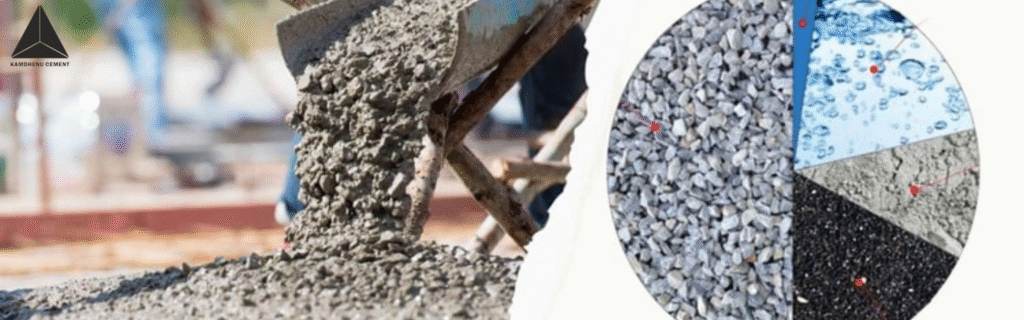
Each component serves a distinct purpose. Cement acts as the binding agent that holds everything together. Fine aggregate (sand) fills voids between larger particles. Coarse aggregate provides structural strength and reduces overall cost. Water initiates chemical reactions and influences workability.
Engineers must consider how these materials interact. The water-cement ratio significantly impacts final strength. Aggregate size affects concrete texture and strength. Material quality influences durability. Proper concrete mix design accounts for all these variables to create concrete suited for specific applications.
Do Yoy Want To Know ? – OPC Cement And PPC Cement
The Role of Indian Standards ( IS )
India follows established guidelines for concrete preparation. The concrete mix design IS code, particularly IS 10262:2019, provides standardized procedures for proportion calculations. These codes emerged from decades of research and real-world testing.
Following the concrete mix design IS code ensures consistency across projects. The standards specify how to determine material proportions based on required compressive strength, available materials, and exposure conditions. Compliance with these codes isn’t just good practice—it’s often a legal requirement for commercial and residential construction.
The IS code addresses various concrete grades from M10 to M60 and beyond. The grades represent the compressive strength after 28 days of curing in megapascals. Increased grades demand increased cement and management of proportions. Special conditions such as high-temperature conditions or chemical exposure are also guided by the code.
Common Mixing Ratios Explained
The conventional construction involves the nominal concrete mix design ratios in the form of cement: sand: aggregate proportions. These ratios are used as fast reference points in standard applications.
The 1:2:4 ratio is still used in general residential work. This is one part cement, two parts sand, and four parts aggregate. This ratio provides sufficient strength to most domestic construction requirements such as walls, slabs, and foundations.
Richer mixes are used in structural elements that demand greater strength. The concrete mix design ratio of 1:1.5:3 has a higher content of cement compared to other constituents. Constructors use it in columns, beams and load bearing structures. The higher cement content increases compressive strength but increases costs.
Non-critical applications can be done with leaner mixes such as 1:3:6. These ratios are appropriate in pathways, plain cement concrete layers, or temporary structures. Their low cement content makes them cost effective but restricts their strength.
Nevertheless, the use of nominal ratios is not entirely satisfactory. These standard proportions do not consider the differences in the quality of materials, moisture content, or special strength needs. Professional projects need to have calculated mix designs depending on the material testing and project specifications.
How Mix Design Calculations Work?
Proper concrete mix design follows a methodical sequence. Engineers begin by establishing project requirements, including desired compressive strength grade, exposure conditions, and workability needs. A column supporting multiple floors needs different concrete than a garden pathway.
Material selection comes next. Testing determines cement grade, aggregate properties, sand gradation, and water quality. Each material’s characteristics influence the final proportions. Moisture content in sand and aggregate must be measured since it affects the amount of water added during mixing.
Calculation involves complex formulas from the IS code. Engineers determine cement content, water-cement ratio, fine aggregate percentage, and coarse aggregate quantity per cubic meter of concrete. These calculations consider material densities, target strength, and desired slump (workability measure).
Trial batches verify theoretical calculations. Small test mixes are prepared, cast into cubes, and tested after curing. Results show whether the design meets strength requirements. Adjustments follow if needed, refining proportions until consistent results emerge.
Admixtures sometimes enter the equation. Chemical additives can improve workability, accelerate or retard setting time, increase durability, or enhance specific properties. Modern concrete mix design often incorporates these materials to achieve performance that basic ingredients alone cannot deliver.
Read More – What Is Bleeding of Concrete
Practical Applications and Common Mistakes
Temperature affects concrete behavior significantly. Hot weather accelerates setting and increases water evaporation, requiring adjustments to maintain proper hydration. Cold conditions slow chemical reactions and may necessitate heated water or protective measures during curing.
Water addition represents the most common error. Site workers frequently add extra water to improve workability, not realizing this severely compromises strength. Every additional liter of water beyond the designed amount weakens the final product. Maintaining strict water control ensures concrete achieves its intended strength.
Material consistency matters more than people expect. Sand moisture varies daily based on weather and storage conditions. Aggregate from different sources may have different properties. Regular testing and proportion adjustments account for these variations.
Proper mixing duration impacts quality. Insufficient mixing leaves pockets of dry material or creates non-uniform concrete. Over-mixing can cause aggregate breakdown and introduce excess air. Following equipment manufacturer guidelines produces optimal results.
Conclusion
Construction quality begins with a proper concrete mix design. Understanding ingredient ratios, adhering to the standards of the IS code, and doing careful calculations help durable structures from those that reach premature failure. Be it small residential projects or big commercial ones, time invested in proper concrete mix design pays off through improved strength, longevity, and reduced maintenance costs.
Quality materials from Kamdhenu Cement, combined with appropriate principles of mixing, result in sound concrete that performs reliably better under stress. Science behind concrete mix design is evolving continuously, yet basic principles remain the same—just the right proportions, quality ingredients, and a sense of attention to detail that time stands the test for.