
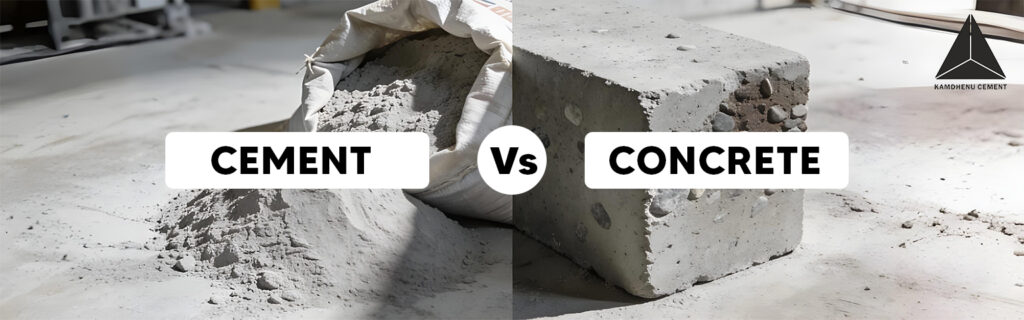
Ever stood at a construction site, wondering why people sometimes call the gray mixture “cement” and other times “concrete”? Well, you are not alone. Many people, even experienced builders, know these terms and use them in construction as if they mean the same. Truthfully speaking, cement and concrete have totally different meanings, which, once understood, will save you from those costly mistakes in your construction project.
Let me illustrate a very common scenario. You go to the hardware store and ask for “cement” to construct your driveway. The shopkeeper may sell you a bag containing grey powder. You go home, mix in water, pour it out, and within days, it starts to crack. Why? Well, you required concrete, not just cement. This misunderstanding occurs a lot more often than you would think, and it is all because someone did not know the difference between concrete and cement.
What exactly is cement?
Think of concrete as the glue that holds everything together. It’s a fine, grey powder made from heating limestone and clay at extremely high temperatures. When you add water to the powder, something magical happens—a chemical reaction called hydration begins, in which the mixture turns into a hard paste.
But here’s the thing: just cement is weak. It can’t hold weight, it can’t weather, and it can’t last. That’s why no one puts a house foundation or road of just cement. It’s one ingredient in the mix, not the mix itself.
Key points relating to cement:
- It is a binder, much like the eggs in a cake recipe.
- It comes as a fine powder that needs careful storage away from moisture.
- Provides the active ingredient that makes concrete work
- Will last for only three to six months if not stored correctly
Among all, you will most probably get Portland cement in India, coming in three variants: OPC-Ordinary Portland Cement, PPC-Portland Pozzolana Cement, and PSC-Portland Slag Cement. All three have different applications but are used as binding materials.
What is concrete, then?
Now, concrete is where things get interesting. If cement is the glue, then concrete is the whole package. It’s what you actually use to build things that will last for decades.
Concrete is a mixture of four main ingredients:
- Cement – the binding agent we just discussed
- Sand – tiny fragments which fill small cracks
- Gravel or crushed stone – larger pieces that add strength
- Water – serves as the activator for the cement and helps hold everything together.
Mixed in the right proportion, these ingredients produce a material that will carry immense buildings, survive earthquakes, and stand strong for centuries. The Hoover Dam? Concrete. The highways you travel on? Concrete. The foundation of your house? Probably concrete.
The beauty of concrete is in its adaptability. Engineers can manipulate the mix to create varying strengths depending upon what they are building. A simple garden path doesn’t need the strength of a multi-story building, so the cement and concrete mix is adjusted accordingly.
The Main Difference Between Cement and Concrete
Now, let’s break down the difference between cement and concrete in a very simple way:
Appearance and Structure: Cement is in powder form and resembles fine dust. Concrete is in solid form, hard, on which you may walk or drive or even build anything.
Strength: By itself, cement is brittle and weak. Concrete has tremendous strength, especially under compressive loads—that is, weight applied from directly above.
Usage: You make concrete using cement. Using concrete, you can build structures. That’s basically the fundamental difference.
Price: A cement bag is way cheaper as compared to ready-mixed concrete, yet you cannot construct anything with cement alone. It’s like buying flour but needing to make bread-you need all the other ingredients too.
Durability: Cement paste deteriorates quickly when exposed to weather. Properly mixed and cured concrete can last 50 to 100 years or more.
Why this makes a difference for your project?
Knowing the difference between concrete and cement isn’t a purely technical point but may just ensure the project goes off with flying colors:
When you know what you need, you can make a properly calculated decision:
- When ordering materials for a project, make sure to order the right amount of material for your project (not just enough to cover the area).
- Order materials conservatively – if anything, save some cash with your order.
- Consider the appropriate time frame for concrete curing when setting up your schedule.
- Throughout the entire project, use a common sense approach when communicating with contractors/suppliers as well.
For example, when you build a garden wall, the likely materials you’ll use will be mortar; ie, cement mixed with water and sand. However, in the case of a driveway that is bound to carry the load of vehicles, one absolutely requires concrete with the entire mixture of aggregates.
How Concrete Gets Its Strength?
The surprising but interesting fact about concrete is that concrete actually does not “dry,” but it goes through a process called hydration. The reason for this is, when you mix cement with water, the two react, producing compounds that are responsible for “curing” the concrete.
This reaction continues for days and even weeks after the concrete is placed, and therefore any time concrete is being cured, it must be kept continuously moist until all the water evaporates off of it, at which time it has become hard.
The method workers use to cure concrete is to continuously spray the concrete slab with water. You may think that spraying the slab with water would be ineffective to its hardening, but it is actually part of the curing process. But the water allows the chemical reaction to fully complete. A rushed process will give you weak and cracked concrete.
Quality concrete achieves its entire strength in 28 days. At this time, engineers test its compressive strength to ensure that it is the exact grade necessary for the job: anywhere from M10 for simple works to M53 for high-scale building and construction.
Making Smart Choices for Your Construction
Whether one is a homeowner renovating or a contractor with large projects, nothing beats good materials. The debate of cement vs concrete isn’t even really a debate-you want both, just used correctly.
When Selecting Cement For Your Concrete Mix, choose a brand that Invests in Quality Control And Advanced Technology In Cement Manufacturing. So by getting reliable cement, you will ensure that your concrete has The Strength And Durability That Are Required For Your Project.
After all, construction Is More Than Just Creating Buildings; It Is About Establishing Trust With The Ability To Create Safe And Secure Structures, Plus The Ability To Ensure That Your Investment Will Be There For Years To Come.
Final Thoughts
The Next Time Someone Uses The Terms “Concrete” And “Cement” Interchangeably… You Will Now Know Better! Cement And Concrete Difference is not much, they are actually quite alike. Cement Is An Important Part Of The Process To Create Concrete (It’s the Ingredient That Bonds All The Other Ingredients Together). Concrete Is What Makes Your Architectural Dreams Become A Reality.
Just Think Of It This Way: Cement To Concrete Is Like Flour To Bread! You need the flour, but it is only one part of making anything substantial and lasting.
For any next construction project, get help from trusted material providers who understand these details and can advise on the right direction. Building with quality materials and at the same time knowledge means building a story of legacy that sheltered generations.
Looking for effective cement in your building? Kamdhenu Cement stands as an epitome of quality, backed by advanced technology and decades of trust, to build structures that stand strong for years.
Read More – kamdhenu cement , ready-mix concrete
Difference between concrete, cement, and mortar
One binding substance used in construction is cement. For sturdy structures, cement, sand, aggregates, and water are combined to create concrete. Brickwork and block joining are the primary uses for mortar, a cement-sand mixture.
When to use cement vs concrete?
Cement is used as a binding agent in plastering and masonry. Concrete is used for structural work like slabs, columns, foundations, and pavements, where strength and durability are essential for long-lasting construction.
Is cement or concrete stronger?
Concrete is stronger than cement because it contains aggregates that add load-bearing capacity. Cement alone cannot handle heavy pressure, while concrete made with quality cement like Kamdhenu ensures durability and structural strength.
Are sidewalks concrete or cement?
Sidewalks are constructed using concrete, not cement. Concrete provides the required strength, weather resistance, and durability to handle continuous foot traffic and outdoor conditions over a long period of time.
Difference between concrete and mortar
Concrete is used for building structural elements like beams, slabs, and roads, while mortar is used for bonding bricks and stones. Concrete contains aggregates, whereas mortar is a simpler mix of cement and sand.