Introduction
When people talk about eco-friendly construction practices, what they usually mean is something like solar panels, rainwater harvesting systems, or even something like the usage of energy-saving windows. Cement is not usually something that comes up in the conversation. But it probably should.
Here’s something that most people do not think about: the cement industry is one of the biggest contributors to CO2 emissions globally. For every tonne of cement that is produced the traditional way, 800 to 900 kg of CO2 is released into the environment. India alone produces over 350 million tonnes annually. The environmental impact is something that adds up quite quickly.
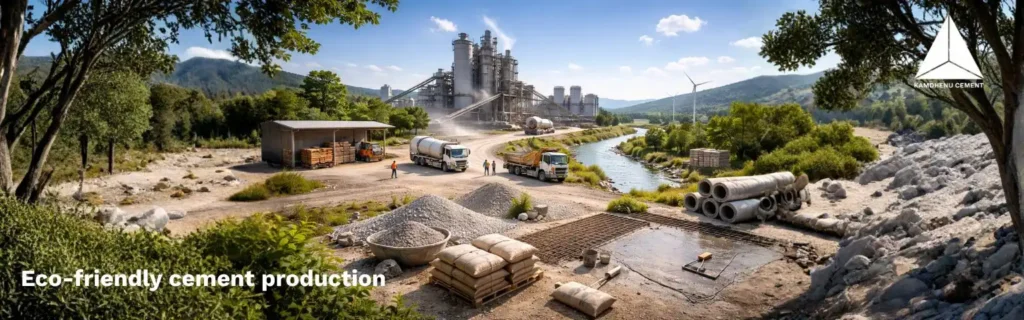
The move towards eco-friendly cement production is a result of this. It’s not just a theoretical exercise either. There is a visible shift in the way cement is manufactured, what it’s made of, and how pollution from cement factories is being controlled. If you’re looking to build a home, an office, or any other kind of structure, this guide will help you build responsively.
What Is Eco-Friendly Cement Production and How Is It Done?
Eco-friendly cement production simply means making cement in a way that causes significantly less environmental damage than the conventional process does.
To understand what that means, it helps to know how regular cement is made. Limestone is mined, crushed, and then fired in a rotary kiln at around 1,450°C. This process — called calcination — breaks limestone down into calcium oxide and releases CO2 as a byproduct. A lot of CO2. On top of that, the fuel burned to run those kilns adds more emissions. It’s an energy-heavy, carbon-heavy process.
Eco-friendly cement production doesn’t throw all of this out. What it does is modify it at multiple points. Some manufacturers replace a portion of the clinker — the most carbon-intensive ingredient — with industrial byproducts like fly ash from thermal power plants or slag from steel plants. These materials are waste products that would otherwise pile up in disposal sites. Using them in cement reduces how much clinker needs to be produced, which cuts both energy consumption and CO2 emissions.
Other changes happen at the plant level — more efficient kilns, waste heat recovery systems that capture heat from the kiln and turn it into electricity, and proper filtration systems that control what escapes from the stacks. A plant doing all of this genuinely earns the eco-friendly label. One that just uses fly ash in the mix but runs no emission controls is really only doing half the job.
Types of Eco-Friendly Cement Available in India
There isn’t one product called “eco cement.” There are several types, each taking a slightly different approach. Here are the main ones you’ll come across:
Portland Pozzolana Cement (PPC) is the most common eco-friendly cement in India and probably the one you’ve already used without thinking much about it. PPC replaces 15 to 35% of the clinker with fly ash, which means less energy consumed during production and less CO2 released. On top of that, fly ash is industrial waste — so using it in cement keeps it out of landfills. PPC also produces concrete that gets denser and more durable over time, which is why most residential and general construction in India uses it.
Portland Slag Cement (PSC) uses granulated slag from steel manufacturing instead of fly ash as the supplementary material. It performs particularly well in chemically aggressive environments — underground structures, marine construction, industrial flooring. If your project involves exposure to sulphates or seawater, PSC is worth considering.
Geopolymer Cement is still relatively new in India but gaining interest. It uses fly ash or slag as the primary binding material, sometimes eliminating clinker almost entirely. CO2 emissions from geopolymer production can be up to 80% lower than conventional cement. It’s not yet widely available for general construction but that’s likely to change.
Blended Cements is a broad category where combinations of supplementary materials — fly ash, slag, silica fume, calcined clay — are mixed with clinker in varying proportions. Most eco-friendly cement production in India falls somewhere under this umbrella.
Top Cement Stocks in India – Best Cement Shares to Buy
What Makes Cement Truly “Green”?
The term green cement gets used loosely, so it’s worth being clear about what it actually requires.
Green cement isn’t just about swapping some clinker for fly ash. It’s about how the entire plant operates. A manufacturer that uses fly ash in the mix but has outdated kilns, no emission monitoring, and no dust controls isn’t really producing green cement. They’re just updating the recipe while keeping everything else the same.
Genuine eco-friendly cement production means lower clinker content, energy-efficient manufacturing, waste heat recovery, responsible raw material sourcing, and proper controls on air pollution in the cement industry at every stage. When all of those are working together, the cement can honestly be called green — not just in marketing but in practice.
Advantages of Using Eco-Friendly Cement
Beyond what it does for the environment, there are real benefits for your project when you use eco-friendly cement:
Your building has a lower carbon footprint. The CO2 that goes into making the materials is part of a building’s environmental impact. Using PPC or PSC instead of OPC reduces this meaningfully, especially on larger projects.
The concrete tends to be more durable in the long run. Fly ash and slag-based cements produce denser concrete that resists water and chemical penetration better than conventional OPC concrete does. Structures built with these cements hold up better over decades, particularly in humid or coastal conditions.
Industrial waste gets used productively. Every tonne of fly ash or slag used in cement is material that doesn’t go into a disposal site somewhere. That’s a genuine environmental benefit on its own.
If your project is targeting GRIHA or LEED green building certification, using eco-friendly cement contributes to the material credits needed for those ratings.
And perhaps the most practical advantage — PPC is generally priced lower than OPC because fly ash costs less to process than additional clinker. So the more responsible choice is often also the more economical one.
How Filtration Technology Tackles Dust Pollution in Cement Plants?
Dust pollution in cement plants is one of the most visible and serious local environmental issues around manufacturing sites. And most people who’ve driven past an older cement plant have seen it — everything nearby covered in a layer of grey-white dust.
Cement production generates particulate matter at almost every stage. Limestone crushing, raw material grinding, kiln operations, clinker cooling, and even bagging all produce dust. Without proper controls, this escapes into the surrounding air. Air pollution in the cement industry from particulates has real health consequences for the communities living nearby — silica dust in particular is linked to serious long-term respiratory disease.
Modern eco-friendly cement production uses several filtration systems to control this:
Electrostatic Precipitators (ESPs) are installed at kilns and clinker coolers where dust generation is highest. They pass exhaust gases through an electric field that charges the dust particles, causing them to collect on plates inside the unit. A properly functioning ESP can capture over 99% of the particulate matter before it reaches the stack.
Bag Filters work on a simpler principle — exhaust air is passed through thousands of fabric filter bags that trap fine particles. These are particularly effective at grinding mills and packing sections where particle sizes are very small and ESPs alone may not be sufficient.
Cyclone Separators are usually the first stage — they spin the airstream so heavier dust particles separate out by centrifugal force before the remaining air goes to the bag filters or ESPs. Think of it as pre-cleaning before the main filtration.
Continuous Emission Monitoring Systems (CEMS) track particulate matter, SO2, NOx, and CO2 at emission points in real time. Plants with CEMS can respond to rising emission levels immediately instead of discovering a compliance issue weeks later during an inspection.
The difference between a plant with all of these running properly and one with none of them is enormous — both in terms of what gets released into the air and in terms of what the surrounding community has to live with. Controlling dust pollution in cement plants isn’t optional if eco-friendly cement production is to mean anything real.
Kamdhenu — The Best Cement in India for Building Responsibly
If you’ve been looking for the best cement in India that actually delivers on both performance and responsibility, Kamdhenu is a name worth trusting.
Kamdhenu has built its position as the no 1 cement in India by doing things properly — and that extends beyond just the product in the bag. The PPC from Kamdhenu uses fly ash in optimised proportions that genuinely improve both the cement’s environmental footprint and its performance in concrete. The manufacturing process includes the emission controls and filtration systems that responsible cement manufacture in India requires. And every product meets BIS standards, so what’s printed on the bag is what’s actually inside it.
For builders, contractors, and homeowners who’ve been let down by cement brands that cut corners on quality or make sustainability claims they can’t back up — Kamdhenu is built to be a different experience. The commitment to quality and to responsible production is consistent across every plant, every batch, and every bag.
Conclusion
The cement industry has a real environmental challenge on its hands, and eco-friendly cement production is the most honest response to it. Whether it’s reducing clinker content, controlling dust pollution in cement plants through modern filtration, or recovering waste heat — every step in the right direction matters.
For your next construction project, choose cement that’s built to last and made with the environment in mind. Choose Kamdhenu. To explore the full range or find a Kamdhenu dealer near you, visit kamdhenucement.com.