
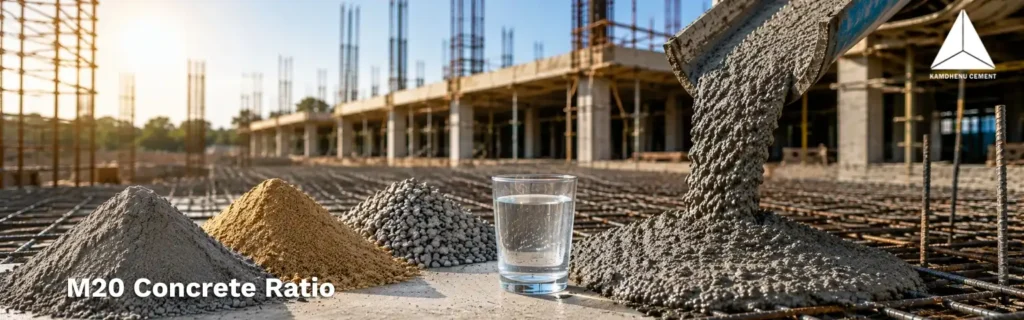
Most people on a construction site know M20 gets specified for slabs, beams, and columns. Fewer can tell you exactly what the M20 concrete ratio is, how to calculate the quantities, or why the m20 ratio concrete fails on site even when the proportions were correct.
That gap between knowing the grade name and understanding the mix is where mistakes happen — material shortages mid-pour, under-strength concrete, curing cut short because the calendar looked inconvenient.
This guide covers the M20 concrete mix ratio, how to calculate material quantities per cubic metre, what those quantities look like in kg, and the practical details that actually affect whether the concrete performs as it should.
What Is M20 Concrete?
M stands for Mix. 20 refers to the characteristic compressive strength — 20 N/mm² — measured on a test cube after 28 days of curing.
In plain terms: if you prepare a sample cube of M20 concrete correctly and cure it for 28 days, it should withstand 20 newtons of pressure per square millimetre before failing. That’s the benchmark the grade is built around, and it’s the number your structural engineer is designing to when M20 is specified.
IS 456:2000 — the Indian Standard code governing reinforced concrete — places M20 in the Standard Grade category. It’s the minimum grade the code allows for RCC structural work. Below M20, the code doesn’t permit reinforced concrete use in load-bearing structural members. That’s why it’s the most commonly specified grade for residential construction.
M20 Concrete Mix Ratio
The M20 concrete mix ratio (nominal mix) is 1 : 1.5 : 3
- 1 part Cement
- 1.5 parts Fine Aggregate (Sand)
- 3 parts Coarse Aggregate (Crushed stone or gravel)
This is the proportion prescribed in IS 456:2000. For most site work — slabs, columns, beams, footings — the m20 ratio concrete of 1:1.5:3 is what gets batched.
There’s also a design mix approach, where a lab determines proportions based on actual testing of the specific materials being used. The design mix may vary slightly from 1:1.5:3 depending on aggregate grading and cement strength. But for standard residential construction, the M20 grade concrete ratio of 1:1.5:3 is what’s used — practical, code-compliant, and consistent when materials are measured properly. This M20 grade concrete ratio is the same one that’s been standard in Indian residential construction for decades.
M20 Concrete Mix Ratio Table
For context, here’s where M20 sits within the common concrete grades used in India.
| Grade | Mix Ratio (Cement : Sand : Aggregate) | Compressive Strength | Typical Use |
| M10 | 1 : 3 : 6 | 10 N/mm² | Lean concrete, blinding |
| M15 | 1 : 2 : 4 | 15 N/mm² | PCC, non-structural work |
| M20 | 1 : 1.5 : 3 | 20 N/mm² | RCC slabs, beams, columns |
| M25 | 1 : 1 : 2 | 25 N/mm² | Heavy RCC, commercial structures |
| M30 | Design Mix | 30 N/mm² | Industrial, prestressed members |
The M20 concrete mix ratio table makes the positioning clear. M15 doesn’t meet the IS code threshold for RCC structural work. M25 is stronger but uses significantly more cement per cubic metre — the cost difference adds up fast across a full residential project. M20 covers most residential structural requirements without overspecifying.
M20 Concrete Ratio in KG (Per 1 m³)
For 1 cubic metre of finished M20 concrete, the approximate material quantities are:
| Material | Quantity |
| Cement | ~400 kg (8 bags × 50 kg) |
| Fine Aggregate (Sand) | ~680 kg |
| Coarse Aggregate | ~1,200 kg |
| Water | ~200–220 litres |
These figures use a dry volume factor of 1.54 and a water-cement ratio of 0.55.
The M20 concrete ratio in kg is more useful on site than proportions alone. When you know you need 8 bags of cement, 680 kg of sand, and 1,200 kg of aggregate per cubic metre, procurement becomes straightforward — and mid-pour shortages become avoidable.
One thing that affects these figures more than most people account for: cement quality. A consistent cement with reliable strength characteristics ensures the mix actually reaches 20 N/mm². Batching correctly and using variable-quality cement is a common reason why the finished concrete tests below grade. Kamdhenu Cement’s OPC and PPC grades are manufactured under quality-controlled conditions specifically to keep that variable stable.
M20 Concrete Ratio Calculation (Step-by-Step)
The 1.54 factor trips people up more than anything else in this calculation. Here’s why it’s there and how the whole thing works.
When concrete is mixed and poured, the aggregate particles pack together and fill voids. The mixed wet volume is less than the sum of the dry materials. To end up with 1 m³ of finished concrete, you need to start with roughly 1.54 m³ of dry materials. That’s the conversion factor.
Step 1 — Total parts in the ratio 1 + 1.5 + 3 = 5.5 parts
Step 2 — Dry volume 1 m³ (wet) × 1.54 = 1.54 m³ (dry)
Step 3 — Cement (1 ÷ 5.5) × 1.54 = 0.28 m³ 0.28 × 1440 kg/m³ = ~403 kg = 8 bags
Step 4 — Sand (1.5 ÷ 5.5) × 1.54 = 0.42 m³ 0.42 × 1600 kg/m³ = ~672 kg
Step 5 — Aggregate (3 ÷ 5.5) × 1.54 = 0.84 m³ 0.84 × 1450 kg/m³ = ~1,218 kg
Step 6 — Water 0.55 × 403 = ~221 litres
The M20 concrete ratio calculation scales linearly — multiply each figure by the volume you actually need. For a 100mm thick slab that’s 10m × 8m, the volume is 8 m³ — multiply everything by 8 and you have your procurement quantities.
Water-Cement Ratio for M20
IS 456:2000 specifies a maximum water-cement ratio of 0.55 for M20. That means for every kilogram of cement, you use no more than 0.55 litres of water.
The honest problem with this on site is that nobody wants to under-pour water. A wetter mix is easier to work — it flows into formwork, fills around reinforcement, and looks easier to compact. But excess water doesn’t become part of the concrete structure. It evaporates, leaving voids behind. Voids mean reduced strength. A mix that was batched to M20 and watered down to pour easily might cure at M15 or below.
If workability is the issue, the answer is a plasticiser — not extra water. Changing the water content changes what the concrete becomes.
How to Mix M20 Concrete (Practical Steps)
Measure accurately. Rough estimates don’t work. A gauge box is the standard site tool for volumetric batching — use it. Weight-based batching is more accurate if you have the setup.
Dry mix before adding water. Combine cement, sand, and aggregate until uniform before introducing water. Skipping this step creates clumps and uneven cement distribution that no amount of wet mixing fixes.
Add water gradually. Not all at once. Add it in while mixing and stop when the mix holds shape without being wet or sloppy. If you’ve hit the right consistency before using all the water in your calculation — stop there.
Mix for at least 2 minutes in a drum mixer. Manual mixing needs to continue until there are no dry patches or colour variation visible in the batch.
Pour immediately and compact properly. Setting starts when water contacts cement. Any delay between mixing and pouring is wasted strength. Use a vibrator to eliminate air voids — hand tamping in RCC work isn’t sufficient.
Cure for 28 days. Keep the surface moist — wet hessian, water ponding, or regular light spraying. The 28-day mark is when M20 reaches rated strength. Stopping at 7 or 14 days is a cost-saving that costs more in the end.
Uses of M20 Concrete
M20 is the standard structural grade for residential construction in India. Here’s where it’s actually used:
RCC roof slabs — the most common M20 application by volume
Beams and columns in residential and small commercial buildings
Footings and foundations under moderate structural loads
Staircases and landing slabs
Retaining walls where lateral loads are within normal residential range
Reinforced driveways and pavements
For heavier structures — large commercial buildings, bridges, or anything with significant point loads — M25 or higher gets specified. The M20 concrete ratio is appropriate where loads and spans fall within standard residential parameters.
Advantages of M20 Concrete
It meets the IS code minimum for RCC. That’s not a small thing. The M20 concrete ratio is the floor for structural reinforced concrete — specifying it means you’re working within IS 456:2000, not below it.
The cost-to-strength ratio is practical. Less cement per cubic metre than M25. For a full residential project, that difference in cement quantity across all the structural pours adds up to real savings.
Workable without additives. The 1:1.5:3 ratio produces a mix that’s manageable on most sites without plasticisers or other admixtures — which reduces variables and cost.
Proven performance. M20 has been the default residential structural grade in India for decades. The contractors, engineers, and material suppliers working with it understand it thoroughly. That familiarity reduces errors.
Common Mistakes to Avoid
Too much water. Already covered — worth repeating because it’s the most damaging and most common error. The concrete feels fine. The cure tells a different story.
Skipping the dry mix stage. Cement doesn’t distribute evenly if water goes in first. The result is a mix with inconsistent bonding throughout.
Using the wrong cement grade. OPC 53 and OPC 43 develop early strength differently. Check what your structural engineer has specified before purchasing. The ratio stays the same — the cement grade isn’t interchangeable without checking.
Stopping curing early. Seven days is not 28 days. The concrete is still developing strength at day 14 and continues past day 28 at a slower rate. Cutting curing short to advance the schedule is cutting the final strength.
Forgetting the 1.54 factor. This is where material shortages happen. Calculating dry materials against a wet volume target gives numbers that are 35% too low. The calculation section above shows exactly how to apply it.
M20 vs Other Grades (Quick Comparison)
Grade | Ratio (Cement : Sand : Aggregate) | Strength | Best For |
M15 | 1 : 2 : 4 | 15 N/mm² | PCC, non-structural |
M20 | 1 : 1.5 : 3 | 20 N/mm² | Residential RCC, standard structural |
M25 | 1 : 1 : 2 | 25 N/mm² | Heavy structural, commercial |
M30 | Design Mix | 30 N/mm² | Industrial, prestressed |
M20 is the practical centre of this table for residential work. Specifying M25 for standard residential RCC adds cost without structural necessity. Specifying M15 for load-bearing elements doesn’t meet IS 456:2000. M20 is the right grade for most residential structural concrete — not a compromise, just the correct specification.
Conclusion
The M20 concrete ratio is 1:1.5:3 — that part is the easy part. What determines whether the concrete on site actually performs at 20 N/mm² is everything that happens after: accurate batching, the right water quantity, proper compaction, and 28 days of curing.
Get the ratio right and cut corners on execution, and the grade doesn’t mean much. Get everything right with a cement that performs consistently, and M20 delivers exactly what it’s rated for.
Kamdhenu Cement manufactures OPC and PPC cement across residential and commercial construction in India — 1.5 million tonnes annual capacity, available in 15 states. For M20 structural work, it’s a cement brand worth specifying.
Visit kamdhenucement.com for product details and dealer locations.