Most people don’t think about cement until they’re standing at a hardware shop with a contractor saying “just get the good one.” That’s not advice. That’s a coin flip — and when the coin lands wrong, you’re looking at cracks in your slab two monsoons later, plaster coming off walls, and a repair bill that hurts.
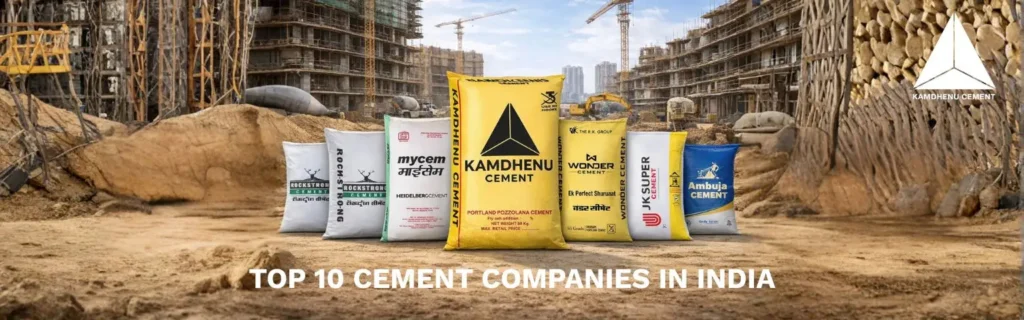
India’s cement production has crossed 400 million Tonnes a year. The National Infrastructure Pipeline is pouring demand into the market — housing, highways, metros, bridges, all going up at once. Which means the top 10 cement companies in India aren’t just large businesses. They’re the reason anything in this country stays standing.
This guide tells you who those companies are, what they actually produce, and which one fits your specific project. Not by marketing. By what the numbers and the product actually say.
Quick Snapshot: Top 10 Cement Companies in India (2026)
| Rank | Company | Market Share | Capacity (MTPA) | Best For | Price Range |
| 1 | UltraTech | ~24% | 133+ | Infrastructure, High-strength | ₹340–380/bag |
| 2 | Ambuja | ~14% | 78+ | Coastal areas, Eco-friendly | ₹330–370/bag |
| 3 | ACC | ~9% | 38+ | Premium quality, Durability | ₹340–375/bag |
| 4 | Kamdhenu | Growing | 1.5+ | Budget-friendly, Availability | ₹300–340/bag |
| 5 | Shree | ~8% | 50+ | North India, Innovation | ₹335–365/bag |
| 6 | Dalmia Bharat | ~5% | 38+ | Sustainability, Premium | ₹330–360/bag |
| 7 | Ramco | ~4% | 20+ | South India, Quality | ₹325–355/bag |
| 8 | JSW | ~3% | 16+ | Fast-setting, Value | ₹320–350/bag |
| 9 | JK Cement | ~3% | 16+ | White cement, Premium | ₹330–365/bag |
| 10 | Heidelberg | ~2% | 8+ | Specialized applications | ₹335–370/bag |
Our Methodology for Ranking the Top Cement Companies in India
This list is not based on companies popularity alone. We looked at four core factors: production capacity, market share, product range, and consumer relevance for different kinds of construction — from homes in small towns to highways in big cities. This approach ensures that the rankings reflect real-world performance and not just brand visibility or advertising presence.
To make the analysis reliable, data from IBEF, ICRA, and company annual reports was used to verify the numbers. These sources provide credible insights into financial strength, operational scale, and industry positioning. We also considered how well each brand caters to different user needs, whether it’s individual home builders or large infrastructure projects.
Freshness of news (expansions, acquisitions) was also factored in so you get the most up-to-date picture. The cement industry evolves quickly, and recent developments can significantly impact a company’s market position, making this list more relevant and practical for current decision-making.
Top 10 Cement Companies in India — Detailed Breakdown
1. UltraTech Cement
Overview: UltraTech is a member of the Aditya Birla Group and was established in 1983 and it is based in Mumbai. It is the largest cement manufacturer not only in India, but also among the leading all over the world.
Key Stats: 194 MTPA capacity, approximate market share of 22 percent, and revenue volume of more than 60,000 crore.
Product Portfolio: OPC, PPC, Ready Mix Concrete (RMC), white cement (Birla White), specialty cements.
Strengths: Unparalleled distribution in 22+ states, more than 1.45 lakh channel partners and 408 RMC plants in 161 cities.No other company among the top cement companies in India has comparable reach.
Best For: Large infrastructure- highways, bridges, commercial towers, and premium housing.
2. Ambuja Cements
Overview: Founded in 1983, under the Adani Group, Ambuja is based in Gujarat and is very active in North and West India.
Key Stats: 108+ MTPA Capacity Market Share Approximately 13% Debt-free status up to 2025
Product Portfolio: PPC, OPC, composite cement, bulk cement.
Strengths: eco-friendly production, emphasis on water conservation and customer service through the ACC Help platform.
Best For: Homebuilders interested in quality that is not compromised on environmental responsibility.
3. ACC Limited
Overview: ACC was established in 1936 and is one of the oldest Indian cement companies, and is currently a member of the Adani Group as well.
Key Stats: 37+ MTPA capacity, about 9 percent market share, 17 factories and 85+ RMC plants.
Product Portfolio: OPC, PPC, bulk cement, Ready mix concrete, specialty blends.
Strengths: Established brand image of close to 90 years, good urbanization, and eco-friendly production by the use of alternative fuels.
Best For: Urban dwelling, institutional, and customers who consider brand tradition.
4. Kamdhenu Cement
Overview:Kamdhenu Cement is a reputable household brand formed in 2002 by Mr. Agarwal and has expanded in 15 states of India. It is based in Delhi, and it is a firm whose production model is unique on a franchise base that enables it to serve the local markets without compromising on quality.
Key Stats: 1.5 MTPA capacity (with a potential capacity of 3 MTPA) | Operating in 15 states | Certified ISO 9001:2008.
Product Portfolio: OPC, PPC and Ready Mix Concrete (RMC) – all manufactured in modern advanced and lab tested facilities.
Strengths: Competitive pricing, quick setting formula, local supply with 60 plus franchise plants and a brand that is trusted by millions of families in India.
Best For: Tier 2 and Tier 3 city residential, middle residential and commercial constructions and affordable constructions where quality cannot be compromised.
Recent Development: lat Kamdhenu Cement is currently working towards expanding its capacity by 3MTPA with the aim of further penetrating more states in India.
You are creating your dream house in a lesser city and you need a brand which will really get to know what you need, which Kamdhenu Cement will bring quality in your door without making a hole in your pocket.
5. Shree Cement
Overview: Shree Cement is the third-largest cement group in India that was established in 1979 in Rajasthan. It is sold under Bangur, Tuff Cemento and Shree Ultra brand.
Key Stats: 66 MTPA and above capacity, approximately 8 percent market share, and business in 18 locations.
Product Portfolio: OPC, PPC, composite cement, power generation (1 GW+).
Strengths: One of the first Indian firms to become a member of the RE100 renewable energy initiative, One of the lowest production costs across all the top 10 cement in India.
Best For: When cost-effectiveness is an important factor in residential and commercial construction.
6. Dalmia Bharat
Overview: Dalmia is one of the older cement companies in India which was established in 1935 and has a good presence in South and East India.
Key Stats: 45+ MTPA capacity and a market share of approximately 6 percent.
Product Portfolio: OPC, PPC, Portland Slag Cement (PSC), composite cement.
Strengths: Low-carbon cement, early-strength formulations, and sustainability leadership.
Best For: Dalmia is one of the most credible names for coastal construction and housing among all top ten cement company in India.
7. Ramco Cement
Overview: Ramco Cement based in Chennai has dominated South India since 1938. It is the casual brand in Tamil Nadu, Andhra Pradesh, Telangana and Karnataka.
Key Stats: 16 + MTPA capacity, approximate market share of 4%.
Product Portfolio: OPC, PPC, SRPC (Sulphate Resistant), RMC.
Strengths: The company has a strong brand loyalty in the south, waste heat recovery systems, and deep regional distribution.
Best For: In South India, any type of construction where the reliability of the local supply can be important.
8. JSW Cement
Overview: This company is relatively new, started in 2009 as a part of the JSW Group, and has been growing rapidly in India.
Key Stats: Capacity of 20 + MTPA, approximated market share of 3 percent, has plans to expand to 60 MTPA.
Product Portfolio:There is GGBS (Ground Granulated Blast Slag), OPC, PPC, and composite cement.
Strengths: environmental friendly slag cement, 84 market share in producing GGBS, and increasing western and southern market share.
Best For: Green building, environmentally friendly infrastructure, and customers interested in using ecologically friendly cement.
9. JK Cement
Overview: It is an Indian-based company that was founded in 1975 under JK Group, and it has a good reputation particularly in the white cement and wall putty.
Key Stats: 15+ MTPA capacity | market share 3 percent | plants in Karnataka, Gujarat, Rajasthan.
Product Portfolio: grey cement (OPC, PPC), white cement, wall putty, waterproof cement.
Strengths: the second-largest white cement producer in India, powerful North and West India network, investment in specialty products research and development.
Best For: Interior wall finishing, ornamentation as well as those buyers who value the surface quality.
10. Heidelberg Cement India, (Mycem).
Overview: Indian affiliate of the German conglomerate Heidelberg Cement, which was founded in India in 2006 under the Mycem brand, and is based in Madhya Pradesh.
Key Stats: Capacity of about 6.3 MTPA | 2-percent market share | 40-90 percent of the renewable energy at its facilities.
Product Portfolio: OPC, PPC, structural cement of premium grade.
Best For: high quality of German engineering, good renewable energy usage, and compressive stability.
Best Cement for Different Use Cases
House Construction: UltraTech, Shree Cement, and Kamdhenu Cement are dependable picks — grade-consistent, widely available, and built for the general demands of residential construction across most of India.
Roof & Slab: OPC 53 grade for maximum compressive performance. UltraTech and ACC are the most commonly specified names for slab work on larger projects.
Foundation: PPC or PSC where soil moisture is high. JSW Cement’s GGBS and Dalmia’s PSC range are both technically strong choices here.
Plastering: PPC is the standard call. Kamdhenu Cement’s PPC, ACC, and Ambuja all deliver consistent results for interior finish work.
Coastal Areas: Ramco’s SRPC and Dalmia’s coastal-grade products are engineered for high-sulphate, high-humidity environments. Using a standard grade near the sea is a mistake that shows up — always later than you expect, always more expensive than you planned.
How to Choose the Best Cement?
First, identify the grade with the job — OPC 53 structural work, PPC finishing. The correct cement type will make your construction have the necessary strength, durability, and finish. As an example, structural components such as beams and slabs require greater strength, whereas plastering and finishing require smoother and more workable cement such as PPC.
Second, availability of checks in your location; a fantastic brand that is not sold in your locality is a logistical nightmare. Supply delays may slow down your project and even compromise the quality of construction in case you have to change brands in the middle of the construction. Regular availability assists in ensuring uniformity during the build.
Third, look at prices per bag but do not base that on being your sole criterion a 20-rupee per bag discount can cost you lakhs in repairs down the line. Never compromise on cost and quality and brand reliability to prevent future problems.
Lastly, request your mason or engineer to share their experience with the brand, as field feedback cannot be replaced. Workers in the cement industry can provide real-life experience on strength, workability, and long-term performance that you cannot get on packaging.
Common Mistakes to Avoid
Many people buy the cheapest brand without checking whether it meets BIS (Bureau of Indian Standards) certification. While it may save money initially, using uncertified cement can lead to poor construction quality and long-term structural issues. It’s always safer to choose a trusted brand that follows proper standards, even if it costs slightly more.
Another common mistake is improper storage. Cement bags are often kept in damp or humid areas, which causes them to absorb moisture and lose strength even before use. Storing cement in a dry, elevated space with proper covering can help maintain its quality.
Mixing too much water into cement is also a frequent error. Although it makes the mix easier to work with, excess water significantly reduces the strength and durability of the final structure. Always follow the manufacturer’s recommended mixing ratios.
Conclusion
Choosing the right cement is not about going with the most advertised brand — it is about matching the right product to your specific need, location, and budget. The top 10 cement companies in India listed here each bring something unique to the table, whether it is UltraTech’s unmatched scale, Dalmia’s sustainability, or Ramco’s southern dominance.
If you are building a home in a Tier 2 or Tier 3 city and want a brand that offers genuine quality at a price that makes sense, Kamdhenu Cement has been doing exactly that since 2002 — one bag at a time, one dream home at a time.
With ISO-certified manufacturing, a fast-setting formula, and a growing presence across 15 states, it is a name that belongs in every serious builder’s consideration. Explore Kamdhenu Cement’s full product range at kamdhenucement.com and take the first step toward a structure that truly lasts.
Which is the best cement company in India for house construction?
The best cement company depends on your location and project needs. UltraTech Cement, Shree Cement, and Kamdhenu Cement are popular choices for residential construction due to their consistent quality, availability, and strength.
What type of cement is best for home building in India?
For structural work like slabs and beams, OPC 53 grade is preferred for high strength. For general construction and plastering, PPC is widely used due to better durability and workability, especially in Indian weather conditions.
How do I choose the right cement brand for my project?
Consider factors like cement type (OPC/PPC/PSC), local availability, brand reputation, and BIS certification. Also, take feedback from your contractor or engineer to ensure the cement performs well in real conditions.
Which cement is best for coastal or high-moisture areas?
For coastal regions, PSC (Portland Slag Cement) or sulphate-resistant cement is ideal. Brands like Dalmia Bharat and The Ramco Cements Limited offer products designed for high humidity and sulphate exposure.
Does a higher cement price mean better quality?
Not always, but extremely cheap cement can indicate lower quality or lack of certification. It’s better to choose a trusted brand that meets BIS standards, even if it costs slightly more, to avoid long-term structural issues.