Introduction – What is Geopolymer Cement?
Ever heard of cement that doesn’t use limestone at all? Sounds odd, right? But that’s geopolymer cement – a completely different type of binding material that’s quietly changing construction.
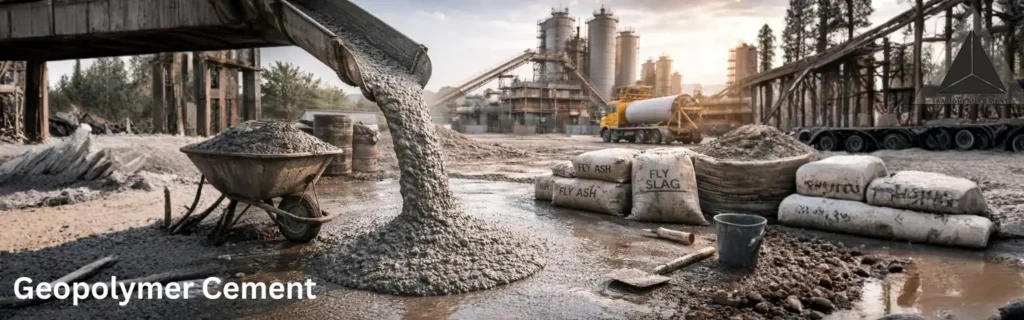
Traditional cement needs limestone and clay heated to extremely high temperatures. Geopolymer cement? It uses industrial waste products instead. Fly ash from power plants. Slag from steel factories. Metakaolin from processed clay. Mix these with special alkaline solutions, and you get concrete that’s often stronger than regular concrete.
The best part? Making it produces way less CO2. Since regular cement manufacturing accounts for roughly 8% of global carbon emissions, this matters enormously.
Whether you’re in construction or just curious about building materials, understanding what geopolymer cement offers shows you where the industry might be heading.
How Geopolymer Cement is Made?
The process is actually straightforward. No massive kilns. No heating to 1450°C like traditional cement requires. Here’s what happens:
Take industrial byproducts – fly ash, slag, or metakaolin. These contain alumina and silica in forms that can react chemically. Mix them with alkaline solutions like sodium hydroxide or sodium silicate. The alkaline activator breaks down the molecular structure of these materials.
This triggers something called geopolymerization. The molecules reorganize themselves into three-dimensional networks. These networks create strong bonds. That’s your binding paste. Add sand, gravel, and water just like regular concrete, and you’re done.
Curing behavior: Geopolymer cement can cure at room temperature or with gentle heating (60-80°C). Some formulations set within hours when heat-cured. Others take longer at normal temperatures but still develop excellent strength. You can control the setting by adjusting how concentrated your alkaline solution is and what curing conditions you use. Regular cement doesn’t give you this flexibility.
What Is Bleeding of Concrete? Meaning, Causes & Segregation Difference
Applications of Geopolymer Cement
Geopolymer cement in India and worldwide is showing up in various construction applications:
Roads and Bridges – Several highway sections in India now use geopolymer concrete. They’re performing excellently under heavy traffic, proving durability in real-world conditions.
Precast Products – Railway sleepers, paver blocks, drainage pipes. Manufacturing these in factories works particularly well because you can control curing conditions precisely, producing high-quality products consistently.
Coastal Structures – Ports and docks face constant seawater exposure. Salt, sulfates, chlorides – all things that eat away at regular concrete. Geopolymer cement resists these attacks much better. Structures last longer.
Industrial Floors – Factories and warehouses need floors that handle heavy loads, chemical spills, and constant wear. Geopolymer concrete delivers this while resisting acids better than Portland cement floors do.
Sewage Plants – The harsh acidic environment destroys regular concrete quickly. Geopolymer cement’s acid resistance extends structure lifespan significantly. Less maintenance, lower costs.
High-Temperature Uses – Furnace linings and similar applications where temperatures reach 1000°C. Regular concrete fails at these temperatures. Geopolymer cement maintains its strength.
Ready Mix Concrete Plant Process & Benefits: Your Complete Guide
Benefits of Geopolymer Cement
Understanding the benefits of geopolymer cement shows why it’s gaining attention:
Environmental Impact – This is huge. Producing it generates 80-90% less CO2 than traditional cement. India generates millions of tons of fly ash annually. Using it in construction transforms waste into valuable material instead of filling landfills.
Lasts Longer – The dense structure resists water penetration. Chemical attacks barely affect it. Structures need less maintenance and serve longer before needing replacement.
Chemical Resistance – Acids, sulfates, chlorides – things that slowly destroy Portland cement concrete don’t significantly harm geopolymer concrete. Perfect for industrial environments and sewage systems.
Fire Performance – Doesn’t burn. Maintains structural integrity at high temperatures where regular concrete spalls and loses strength. Buildings become safer.
Quick Strength – With proper heat curing, it achieves high strength within 24 hours. Construction schedules accelerate. Projects finish faster without compromising quality.
Protects Reinforcement – Low permeability keeps water and harmful chemicals from reaching steel reinforcement. No corrosion means structures last dramatically longer.
Uses Waste – Every ton uses industrial waste that would otherwise need disposal. Good for construction. Good for waste management. Win-win situation.
Limitations & Challenges to Know
Despite benefits, real challenges limit widespread adoption:
Inconsistent Materials – Fly ash quality varies significantly depending on where it comes from. Different coal types produce different fly ash. This makes standardizing mixes difficult. You can’t use any fly ash and expect identical results.
People Don’t Know About It – Most builders and contractors aren’t familiar with this technology. People stick with what they know. Changing decades of Portland cement practices takes time and education.
No Official Standards Yet – India doesn’t have comprehensive standards specifically for geopolymer cement. This makes architects and engineers hesitant. Insurance and approval becomes complicated without established guidelines.
Handling Safety – The sodium hydroxide and sodium silicate solutions are caustic. Workers need proper safety equipment and training. Regular concrete mixing is simpler and safer.
Mix Design Precision – Getting it right requires more precision than regular concrete. Small variations in activator ratio, curing conditions, or temperature significantly affect final properties.
Supply Chain Issues – You can’t just call any supplier and order it like Portland cement. Availability varies by region. Sourcing materials can be challenging, especially for smaller projects.
Cost Concerns – The specialized activators and knowledge required make it seem expensive initially. Many builders focus on upfront costs rather than long-term savings, even though lifecycle costs are often lower.
READ MORE- OPC cement , PPC cement , Ready mix concrete
Conclusion
Geopolymer cement represents a promising shift toward sustainable construction. It’s an innovative binding material using industrial waste to create concrete that’s often stronger, more durable, and far more environmentally friendly than traditional cement.
The benefits are clear – drastically reduced CO2 emissions, superior durability, excellent chemical resistance, and productive waste utilization. As awareness grows and standards develop, geopolymer cement in India and globally will likely see increased adoption.
However, challenges around raw material consistency, limited awareness, lack of standards, and supply chain development need addressing first. For now, it remains specialized – used where its specific benefits justify the additional complexity.
Kamdhenu Cement stays committed to bringing sustainable construction solutions to India’s building industry. As the technology matures and becomes more accessible, geopolymer cement could play an important role in reducing construction’s environmental impact while delivering superior performance.
What is geopolymer cement made of?
Industrial byproducts like fly ash, slag, or metakaolin activated with alkaline solutions (sodium hydroxide or sodium silicate), creating strong binding materials without traditional limestone.
Are geopolymers cheaper than concrete?
Initial costs may be slightly higher, but longer lifespan, reduced maintenance, and superior durability often make geopolymer concrete more cost-effective over time.
What are the disadvantages of geopolymer concrete?
Main disadvantages include inconsistent raw material quality, limited awareness and standards, need for precise mix design, handling of caustic solutions, and developing supply chains.
How strong is geopolymer cement compared to regular cement?
Often achieves equal or higher compressive strength than Portland cement, with some mixes exceeding 70 MPa while offering superior durability in harsh environments.
Is geopolymer cement available in India?
Yes, geopolymer cement in India is available through specialized suppliers and research institutions, though not as widely accessible as traditional cement. Availability is growing steadily.