
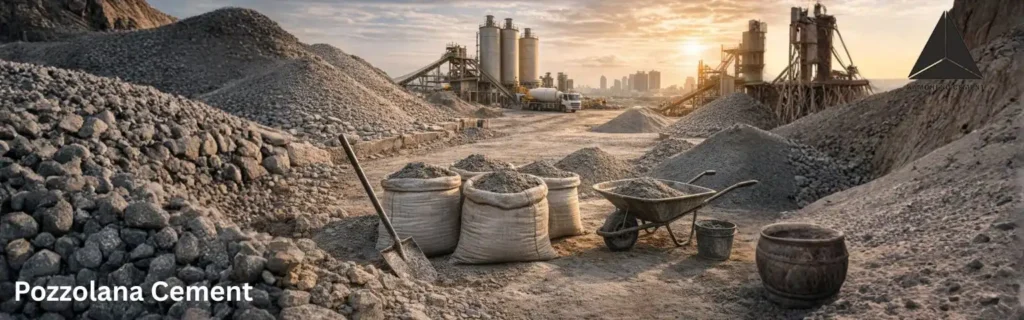
Walk through any construction site in India and chances are the cement being used contains pozzolana. It’s in the majority of cement bags you see. But ask most people what pozzolana actually is and you’ll get blank stares.
Pozzolana cement – specifically Portland Pozzolana Cement (PPC) – has become the dominant cement type for general construction work across India. There’s good reason for that. It performs better in certain conditions, costs less, and handles India’s climate challenges better than regular Portland cement.
If you’re planning construction work or just trying to understand why your contractor specified PPC instead of OPC, here’s what pozzolana cement actually means and why it matters for your project.
So What Does Pozzolana Cement Actually Mean?
The meaning behind the term pozzolana cement dates back almost 2,000 years. Pozzuoli is a small town in Italy, near Mount Vesuvius, where a type of volcanic ash has a rather curious property: if you mix it with lime and water, it turns into something that is almost like stone. The Romans discovered this and used it to build the Pantheon, massive aqueducts, and harbor buildings that are still standing today. That is no accident, that is the chemistry of pozzolana cement at work.
Now, fast-forward to today, and we find that Portland Pozzolana Cement (PPC) is essentially the same thing, just in a modern, engineered form. It is a mixture of Portland cement clinker and pozzolanic materials, in a ratio of 65 to 85% and 15 to 35% respectively, with a small amount of gypsum added to control the rate at which it sets. The pozzolanic materials are not cement on their own, but when they are exposed to the chemicals that are created when cement is hydrated, a second set of chemical reactions takes place that actually make your cement stronger and denser over time.
That’s the pozzolana cement meaning in plain terms — not just Portland cement with something mixed in, but a smarter material that keeps working long after the concrete is poured.
Chemical Composition of Pozzolana Cement
When Portland cement mixes with water, one of the byproducts it releases is calcium hydroxide — Ca(OH)₂. In regular OPC concrete, this just sits there as a relatively weak element inside the concrete structure. But in pozzolana cement, the silica from the pozzolanic material reacts with this calcium hydroxide and forms something called Calcium Silicate Hydrate (C-S-H):
Ca(OH)₂ + SiO₂ + H₂O → C-S-H
C-S-H is the same compound responsible for concrete’s core strength. So essentially, pozzolana is converting a weak byproduct into something useful. It fills the microscopic pores inside the concrete, making the whole structure denser, tighter, and more resistant to water and chemicals.
Here’s a quick look at what’s inside pozzolana cement:
Portland Cement Clinker (65–85%):
- Tricalcium Silicate (C₃S) — 45–60%
- Dicalcium Silicate (C₂S) — 15–30%
- Tricalcium Aluminate (C₃A) — 6–12%
- Tetracalcium Aluminoferrite (C₄AF) — 6–8%
Pozzolanic Material (15–35%):
- Silicon Dioxide (SiO₂) — 40–70%
- Aluminium Oxide (Al₂O₃) — 10–30%
- Iron Oxide (Fe₂O₃) — 5–15%
Gypsum (3–5%) to regulate the setting time.
The balance of these components is what makes pozzolana cement behave differently from plain OPC — and in most situations, better.
How Pozzolana Cement Is Actually Made?
The manufacturing side isn’t complicated, but where quality can go wrong is in the details.
The clinker gets made the usual way, limestone and clay go into a rotary kiln, get fired at around 1,450°C, and come out as those hard grey nodules you might’ve seen at a cement plant. That part is standard across OPC and PPC both.
What’s different is the fly ash side. In India, fly ash comes mostly from coal-fired thermal power plants. It’s collected from the flue gases, dried, and ground down. And here’s the thing — not all fly ash is equal. The source matters. The particle size matters. Coarser fly ash reacts slowly and doesn’t contribute much. Finer fly ash reacts better and faster. A manufacturer cutting corners on fly ash quality is giving you cement that looks fine on the bag but underperforms in the slab.
After the fly ash is ready, it gets ground together with the clinker and gypsum in specific ratios. Then testing — compressive strength at 3, 7, and 28 days, fineness checks, setting time, chemical composition. Indian PPC has to meet IS 1489 before it goes to market. Brands that take this seriously test continuously, not just occasionally.
This is why Pozzolana in Indian Cement Production has gotten so reliable over time. India’s thermal power sector generates fly ash at massive scale, and manufacturers have built proper quality systems around it. The raw material availability and the testing infrastructure are both there — it just comes down to whether a company actually uses them properly.
What Types of Pozzolanic Materials Are Used?
Not every pozzolana is the same. Here are the main ones:
Fly Ash is by far the most widely used in India. It’s a byproduct of coal combustion and India produces enormous quantities of it. It performs consistently and is cost-effective to process, which is why it dominates Pozzolana in Indian Cement Production.
Natural Volcanic Ash was the original pozzolana — the stuff the Romans used. It’s still found and used in some parts of the world but is less common in Indian cement manufacturing today.
Calcined Clay is clay that’s been heated to a specific temperature to develop reactive silica. It’s growing in importance as some regions tighten regulations around fly ash sourcing.
Silica Fume is extremely fine silica produced as a byproduct of silicon metal manufacturing. It’s very reactive but used mainly in high-performance or specialty concrete, not general construction cement.
Rice Husk Ash is still at an experimental stage but holds real promise for India given our scale of rice production. Under controlled burning, rice husk produces highly reactive silica.
Benefits of Pozzolana in Cement
Pozzolana cement offers several advantages over Ordinary Portland Cement for many applications:
Better Long-Term Strength – While early strength develops slower than OPC, PPC eventually reaches higher strength. The pozzolanic reaction continues for months, densifying concrete over time. For structures expected to last decades, this matters.
Improved Durability – The secondary reactions from pozzolana fill microscopic pores in concrete. This makes concrete less permeable to water and chemicals. In practice, this means better resistance to sulfate attack, chloride penetration, and chemical corrosion.
Lower Heat Generation – Pozzolana cement generates less heat during hydration compared to OPC. For large concrete pours where heat buildup can cause cracking, this is significant. Mass concrete work – dams, large foundations, thick walls – benefits from lower heat generation.
Better Workability – Concrete made with pozzolana cement tends to be more workable and easier to place. Masons find it easier to work with, which can improve construction quality.
Reduced Permeability – The denser concrete structure from pozzolanic reactions reduces water permeability. This helps in foundations, water retaining structures, and any concrete exposed to moisture.
Resistance to Alkali-Silica Reaction – Pozzolana consumes free lime in concrete, reducing the risk of alkali-silica reaction which can cause concrete to crack and deteriorate over time.
Cost Effectiveness – Pozzolana cement typically costs less than OPC because pozzolanic materials like fly ash cost less than clinker to produce. For budget-conscious projects, this price difference adds up.
These benefits explain why pozzolana cement has become so prevalent in Indian construction.
Where Is Pozzolana Cement Used?
The pozzolana cement uses in India cover a wide range of work, which is part of why it’s become so dominant:
For homes and apartments, PPC handles everything — walls, columns, slabs, plastering, flooring. The workability and long-term strength make it ideal for residential construction, and most contractors specify it by default.
For mass concrete work like dams, large foundations, and thick retaining walls, the low heat generation makes PPC not just preferable but often essential. Thermal cracking in mass concrete is a serious structural risk and PPC reduces it significantly.
For coastal and marine construction — ports, jetties, seawalls, any structure near saltwater — the resistance to chloride penetration and sulfate attack makes PPC far more suitable than OPC.
For water-retaining structures like tanks, reservoirs, and drainage systems, the reduced permeability of PPC concrete is exactly what’s needed.
For underground work — basements, foundations, below-grade structures — exposure to soil chemicals is ongoing and PPC handles it better over the long run.
Where pozzolana cement is not the right choice: if you need very high early strength, like in precast production or rapid construction with tight formwork cycles, OPC is the better call. Same for prestressed concrete. But for the vast majority of standard construction work in India, PPC covers it well.
Why Kamdhenu Is the No 1 Cement in India for This?
There are a lot of cement brands in India. The difference with Kamdhenu isn’t just the product — it’s the consistency behind it.
Every batch of Kamdhenu pozzolana cement is tested against IS 1489 specifications before it leaves the plant. The fly ash used is carefully selected and processed, because not all fly ash performs the same way. Source matters, particle size matters, reactivity matters — and Kamdhenu controls each of these variables closely.
The result is cement that behaves predictably. When a structural engineer designs a concrete mix around certain assumptions, those assumptions hold true on the Kamdhenu bag. That reliability is what earns trust with contractors who’ve been using the same brand across dozens of projects.
Kamdhenu also formulates specifically for Indian conditions — the heat, the humidity, the monsoon, the construction practices common here. A cement that performs well in Germany or the US doesn’t automatically perform the same way on an Indian site in May. Kamdhenu’s cement does.
And with a distribution network across India, the cement reaches sites on time. Projects don’t get delayed waiting for stock.
That combination — consistent quality, Indian-specific formulation, and dependable availability — is what has made Kamdhenu the no 1 cement in India for builders who take their work seriously.
Conclusion
Pozzolana cement works because the chemistry works. It takes a waste byproduct inside concrete and converts it into something that makes the whole structure stronger, denser, and more durable. For most construction in India — homes, buildings, infrastructure — it’s simply the better material.
If you want those benefits backed by manufacturing you can trust, Kamdhenu is where to start. Visit kamdhenucement.com to explore products or speak with a technical advisor for your specific project.