Introduction to White Cement and Grey Cement
Walk into any hardware store and you’ll see bags of cement stacked everywhere. Grey cement dominates. White cement sits in a smaller corner, costing more. Both look like powdered cement. Both harden into solid structures.
So what’s actually different? More to the point, what one do you require?
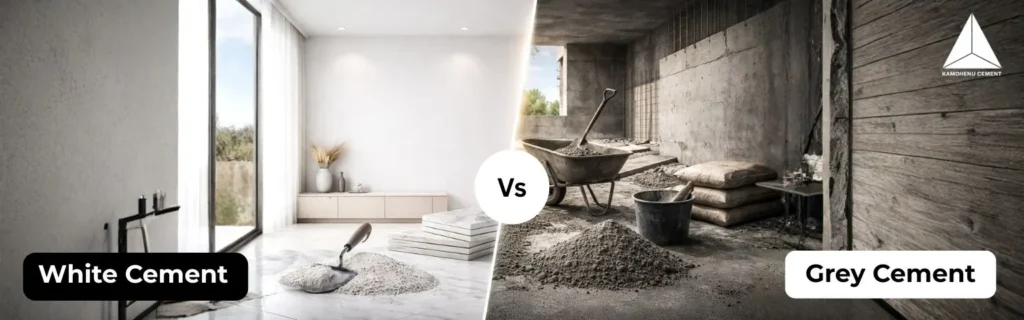
The difference between white cement and grey cement is important since the wrong cement is a waste of money or causes inconveniences. Grey cement is very good in structural work but destroys decorative finishes. White cement is very beautiful to look at but it is very expensive to use in general construction.
What Is Grey Cement?
Grey cement is standard construction cement. The workhorse. That grey color comes from raw materials, primarily iron oxide and manganese oxide.
Manufacturing – Limestone, clay, and iron ore get heated in kilns at 1400-1500°C. The resulting clinker is ground with gypsum. Those iron compounds create the grey color.
Types – Includes OPC (Ordinary Portland Cement), PPC (Portland Pozzolana Cement), and PSC (Portland Slag Cement). Each has specific applications.
Common Uses – Foundations, columns, beams, slabs, plastering, brickwork, roads, bridges. Basically everything structural. If it needs strength and you’re covering it anyway, grey cement handles it.
The grey color doesn’t affect strength. It just means iron oxide is present.
What Is White Cement?
White cement is premium cement manufactured specifically for pure white color. Identical basic make-up as grey cement but with vital disparities in raw materials and processing.
Manufacturing – Limestone and china clay are used with little iron and manganese. Raw materials are also chosen with care to remove impurities that cause color. More complex process. Higher energy consumption. This is why the price of white cement vs grey cement is so different.
Composition -High calcium and low iron/magnesium. The purity produces pure white color that remains unchanged.
Uses Decorative work, tile adhesive, wall putty, grout, ceiling finishing, textured paints, sculptures, artistic concrete. Anywhere appearance matters and you want that clean white base.
White cement provides the perfect canvas for colored finishes. Add pigments and you get exactly the shade wanted without grey undertones.
White Cement vs Grey Cement: Key Differences
Let’s compare the actual differences between white and grey cement affecting your decision.
Color – Grey cement is grey from iron oxide. White cement is pure white from low-iron raw materials. Color affects every decorative application.
Manufacturing Complexity – Grey cement uses standard materials and processes. White cement requires purer materials, controlled processing, specific cooling. Higher complexity equals higher costs.
Applications – Grey cement handles structural work. White cement dominates decorative applications.
Cost – Grey cement is economical. White cement costs 2-3 times more per bag. For large structural work, using white cement would be financially absurd.
Setting Time – Both set within similar timeframes. Minimal practical difference.
Finish Quality – Grey cement creates grey surfaces needing paint or covering. White cement provides smooth, bright finishes looking premium without additional coatings.
Availability – Grey cement is everywhere. White cement is selective—available but not universally stocked.
White Cement vs Grey Cement: Strength Comparison
Does color affect strength? That’s the question about white cement vs grey cement strength.
Compressive Strength – Grey cement typically ranges 33-53 MPa depending on grade. White cement achieves similar compressive strength, often 42.5-52.5 MPa for quality brands. The strength is comparable.
Structural Applications – Both can be used structurally. Grey cement is standard because it’s cheaper, not stronger. White cement has adequate strength but cost makes it impractical.
Durability – Grey cement with proper curing lasts decades. White cement offers similar durability when properly installed. Both resist weathering when correctly formulated.
Myth Busting – White cement isn’t weaker. It’s just more expensive. The white cement vs grey cement strength difference is negligible. You use grey cement for structural work because of economics, not strength.
For load-bearing structures, grey cement makes financial sense. For decorative work where aesthetics matter, white cement’s appearance justifies the premium.
Price Difference Between White and Grey Cement
Money matters. Let’s talk white cement vs grey cement price.
Grey Cement Pricing – Typically ₹300-400 per 50kg bag depending on brand, type, and location. Bulk purchases reduce costs further.
White Cement Pricing – Ranges ₹900-1200 per 40kg bag. Some premium brands charge more. That’s 2.5-3 times the cost per kilogram.
Why the Gap? – Raw materials cost more. Manufacturing requires more energy and control. Production volumes are lower. Quality control is stricter. All these drive prices up.
Cost Implications – Using white cement for structural work adds lakhs unnecessarily. Using grey cement for decorative finishing gives grey-tinted results needing heavy paint coverage.
Value Consideration – For finishing work, tile adhesive, wall putty, or exposed cement aesthetics, white cement’s premium is justified. For hidden structural work, grey cement is smart.
Smart builders use both strategically. Grey cement for structure. White cement for finishing. That balance optimizes budget and aesthetics.
When to Use White Cement vs Grey Cement?
Choosing between white cement vs grey cement depends entirely on application.
| Feature/Application | Grey Cement | White Cement |
| Structural Core | Foundations, footings, columns, beams, and slabs. | Not typically used for heavy structural load-bearing. |
| Masonry & Prep | Brickwork, blockwork, and rough plastering. | Wall putty and final finishing coats on walls/ceilings. |
| Tiling | Sub-floors and bedding for thick-set tiles. | Tile adhesives and grout for clean, bright lines. |
| Infrastructure | Concrete roads, pavements, and heavy civil works. | Decorative concrete finishes and exposed surfaces. |
| Aesthetics | Used when the surface will be buried or covered. | Used when the cement surface remains visible. |
| Feature/Application | Grey Cement | White Cement |
Combination Approach – Most projects use both. Grey cement for structure and hidden work. White cement for visible finishing. This optimizes costs while maintaining quality.
Factors to Consider When Choosing Cement
Beyond just understanding the differences between white and grey cement, what else matters?
Project Requirements – What are you building? Structural elements need grey cement. Decorative finishes want white cement. Match material to purpose.
Budget Constraints – Can you afford white cement where needed? If budget is tight, grey cement with quality paint works for most applications.
Aesthetic Goals – Want exposed cement finishes? Planning designer walls? White cement delivers superior aesthetics. If everything gets painted anyway, grey cement suffices.
Location and Availability – Is white cement readily available in your area? Rural locations might have limited stock. Grey cement is universal.
Brand Quality – Regardless of color, choose reputable brands. Kamdhenu Cement manufactures both types with consistent quality standards. Poor quality cement – white or grey, creates problems.
Professional Advice – Consult your contractor or architect. They understand local conditions, specific project needs, and where each cement type adds value.
Conclusion
The differences between white and grey cement come down to raw materials, manufacturing process, appearance, and cost. Strength is comparable. Applications differ dramatically.
Grey cement is the construction workhorse. Economical. Strong. Perfect for structural work and hidden surfaces.
White cement is the finishing specialist. Premium pricing. Beautiful aesthetics. Ideal for decorative work and visible surfaces.
Smart construction uses both strategically. Grey cement handles the heavy lifting. White cement polishes the final presentation.
In Kamdhenu Cement, we produce quality cement products because we know that various applications require various solutions. You may require a good grey cement to do structural work or a good white cement to do finishing touches, but when you select the right cement, your project will be a success.
Do not pay too much by applying white cement where grey cement is the best. Don’t compromise aesthetics by using grey cement where white cement shines. Match the material to the purpose.
What is the main difference between white cement and grey cement?
The main difference is color and use. Grey cement is mainly used for structural construction, while white cement is used for decorative finishes and aesthetic applications.
Is white cement stronger than grey cement?
No, both white and grey cement offer similar strength. Grey cement is used more for construction because it is more affordable.
Why is white cement more expensive than grey cement?
White cement uses purer raw materials and requires a more controlled manufacturing process, which increases production costs.
Where is white cement commonly used?
White cement is mainly used for wall putty, tile grout, decorative concrete, textured finishes, and other applications where appearance matters.
When should grey cement be used in construction?
Grey cement is best for foundations, columns, beams, brickwork, and plastering where strength is needed and the surface will be covered later.