
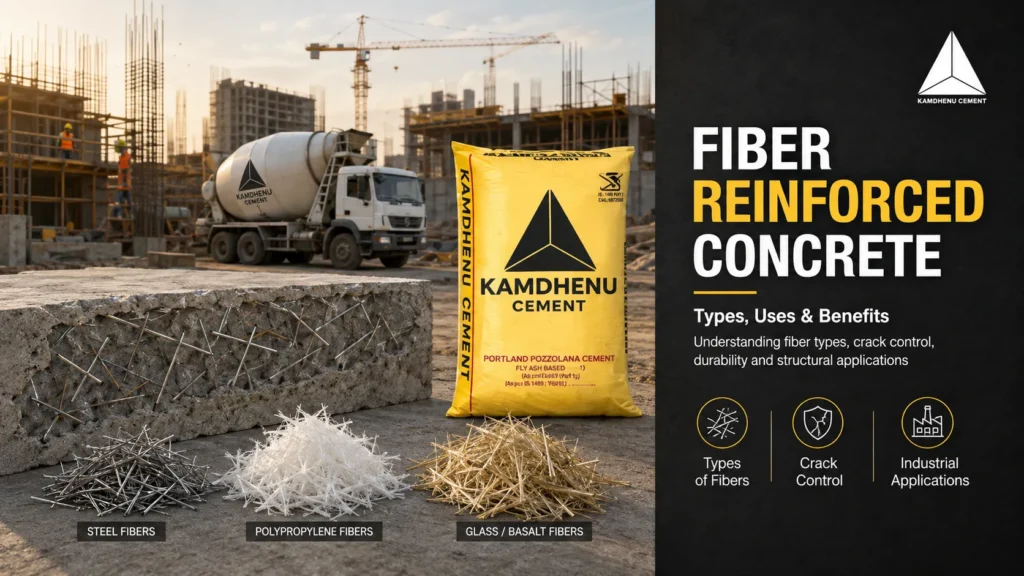
Standard concrete handles compression well and fails under tension, that’s why steel reinforcement bars exist. Fiber reinforced concrete addresses the same problem from a different angle: instead of bars, it uses short fibers distributed throughout the mix that resist crack formation and propagation from within. The result is a concrete that’s more resistant to cracking, more durable under impact and fatigue loads, and more consistent in performance across large pours.
FRC concrete — fiber reinforced concrete, isn’t a new concept, but its applications have expanded significantly. Steel fiber reinforced concrete for industrial flooring, polypropylene fiber reinforced concrete for slabs and tunnels, and synthetic fiber reinforced concrete for crack control in residential construction are all established specifications. Understanding what each type delivers and what it costs, helps project owners and engineers decide when the upgrade is justified.
Kamdhenu Cement supplies OPC and PPC grades for both standard RMC and fiber reinforced concrete applications. The cement quality going into an FRC mix is as important as the fiber type — consistent C3S content and proper water-cement ratio control determine how well the composite performs.
What Is Fiber Reinforced Concrete (FRC)?
Fiber reinforced concrete is concrete in which short, discrete fibers are uniformly distributed through the mix during batching. The fibers can be steel, polypropylene, glass, basalt, or natural materials — each with different mechanical properties and applications.
The fibers don’t replace conventional reinforcement bars in structural elements. They work differently: fibers resist crack widening and provide post-crack load capacity that unreinforced concrete doesn’t have. In structural applications, FRC is often used alongside conventional steel bars, not instead of them.
How Does Fiber Reinforced Concrete Work?
When concrete cracks — from shrinkage, impact, or load — cracks propagate through the matrix by following the path of least resistance. In plain concrete, nothing interrupts this propagation. In fiber reinforced concrete, fibers bridging the crack resist its opening, redistribute stress, and limit how wide and how far the crack extends.
This mechanism makes FRC particularly effective for:
- Shrinkage crack control in slabs
- Impact and fatigue resistance in industrial floors
- Tunnel linings and sprayed concrete applications
- Thin-section precast elements
The improvement is measurable — FRC consistently shows better toughness (energy absorption before failure) and residual strength after first crack than plain concrete.
Types of Fibers Used in Concrete
| Fiber Type | Material | Aspect Ratio | Key Property | Common Use |
| Steel | High carbon wire or cold-drawn | 40–80 | Tensile strength, toughness | Industrial floors, tunnels |
| Polypropylene | Synthetic polymer | 100–200 | Crack control, chemical resistance | Slabs, residential concrete |
| Glass | Alkali-resistant glass | 30–100 | Tensile strength, light weight | Precast panels, facades |
| Basalt | Volcanic basalt rock | 50–100 | Corrosion resistance, durability | Marine, harsh environments |
| Natural | Jute, coir, sisal | Varies | Sustainability, low cost | Rural construction, limited use |
| Macro-synthetic | Structured polypropylene | 40–80 | Post-crack load bearing | Floors, industrial applications |
Steel and polypropylene are by far the most common in Indian construction. Glass fiber is primarily used in prefabricated elements. Basalt is growing in coastal and marine applications.
Advantages of Fiber Reinforced Concrete
Crack control. The most consistent fiber reinforced concrete advantage. Fibers limit crack width at early age (plastic shrinkage) and restrain crack propagation under load. This translates directly to durability — narrower cracks mean less ingress of water and chemicals.
Improved toughness. Toughness — the ability to absorb energy before failure — increases substantially with fiber addition. This makes FRC significantly better than plain concrete under impact loads, which is why it’s specified for heavy duty concrete flooring in warehouses, factories, and vehicle parking structures.
Reduced maintenance. Crack-resistant concrete surfaces require fewer repair cycles over the life of a structure. For industrial floors where production downtime for floor repairs is expensive, this has a direct cost return.
Better fatigue resistance. Under repeated loading — typical in industrial facilities, pavements, and bridge decks — FRC sustains a higher proportion of its static strength through load cycles than unreinforced concrete.
Uniform reinforcement. Fibers are distributed through the entire volume of concrete. There are no cover requirements, no placement tolerances to manage, and no zones where reinforcement is absent. This is particularly advantageous in thin sections and irregular shapes.
Fiber Reinforced Concrete vs Normal Concrete
| Property | Fiber Reinforced Concrete | Normal Concrete |
| Crack resistance | Significantly higher | Limited to concrete tensile strength |
| Toughness | Much higher | Brittle after cracking |
| Shrinkage cracking | Reduced 50–70% | Higher |
| Fatigue strength | Improved | Standard |
| Impact resistance | Higher | Lower |
| Mix complexity | More controlled batching | Standard |
| Cost | 8–20% higher per m³ | Baseline |
| Best for | Industrial floors, tunnels, structural overlays | General residential RCC |
The fiber reinforced concrete vs normal concrete comparison isn’t about one replacing the other, it’s about matching the specification to the performance requirement. Normal concrete does its job in most applications. FRC is the specification when crack control and post-crack performance are part of the design requirement.
Steel Fiber Reinforced Concrete: Uses and Applications
Steel fiber reinforced concrete uses span some of the most demanding applications in construction.
Industrial flooring — this is the dominant application in India. Factory floors, warehouse floors, cold storage slabs, and logistics hub floor slabs all benefit from the crack resistance and fatigue performance steel fibers provide. A steel fiber dosage of 30–40 kg/m³ in an M40 or M45 concrete mix is typical for heavy industrial flooring.
Tunnel linings — sprayed concrete (shotcrete) for tunnel support almost universally uses steel fibers to replace traditional wire mesh. Fibers are more compatible with spraying processes and eliminate the mesh fixing labour.
Precast elements — box culverts, tunnel segments, railway sleepers, and retaining wall panels use steel fiber reinforced concrete for impact and load resistance.
Airport pavements — the fatigue loading profile from aircraft requires concrete with higher toughness than standard airfield slabs. Steel FRC meets this requirement.
When Should You Choose Fiber Reinforced Concrete Over Standard RMC?
The decision criteria are relatively clear once the application is defined.
Choose FRC when: The slab will carry heavy or repetitive loads (industrial floors, vehicle areas). Crack control is critical to function or aesthetics. The element is a tunnel lining, precast structural element, or overlay on existing concrete. Maintenance access is difficult or downtime from repairs is expensive.
Stay with standard ready mix concrete when: The application is general residential RCC — columns, beams, slabs in a conventional building where designed conventional steel reinforcement handles the structural load. FRC concrete for industrial flooring is the right answer; FRC for a residential staircase column is overspecified.
Fiber Reinforced Concrete Price in India: Is It Worth the Extra Cost?
Fiber reinforced concrete price in India varies by fiber type, dosage, and regional supply.
Steel fiber addition: ₹150–₹250 per kg; typical dosage 25–50 kg/m³ adds ₹4,000–₹12,000 per m³ to the base concrete cost.
Polypropylene fiber addition: ₹120–₹200 per kg; typical dosage 0.6–1.5 kg/m³ adds ₹100–₹300 per m³ — a much smaller premium, focused on crack control rather than structural performance.
For industrial flooring where the base concrete might cost ₹6,000–₹8,000 per m³, steel fiber adds 50–100% to the concrete material cost. The economic case rests on floor life and maintenance: a steel FRC floor that needs no repair cycles over 15 years versus a plain concrete floor that requires significant maintenance at year 5 and year 10. For industrial operations where floor downtime costs are significant, the total cost comparison usually favours FRC.
For residential applications, polypropylene fibers at low dosage add marginal cost (under 5% of concrete cost) for a meaningful improvement in early-age crack resistance.
Limitations of Fiber Reinforced Concrete
Fibers are not a cure-all for concrete problems.
Workability reduction. Steel fibers in particular reduce slump. Mixes need adjustment — often with superplasticizer addition — to maintain adequate workability.
Fibre balling. If fibers are added incorrectly or in excessive dosage without proper mixing, they can clump. This is a batching plant quality issue, not an inherent FRC problem, but it requires controlled mixing procedures.
Not a replacement for structural rebar. FRC provides post-crack ductility, not the primary tensile resistance that designed reinforcement provides in beams and columns. Using fibers as a rebar substitute in structural elements is incorrect specification.
Cost visibility. The benefits of FRC — fewer cracks, longer floor life — are visible only over time. Upfront cost comparison with plain concrete looks unfavourable; lifecycle cost comparison does not.
Conclusion
Fiber reinforced concrete advantages are most clearly realised in applications with specific performance demands — industrial flooring, tunnels, precast elements, and overlays. For general residential RCC, the concrete reinforcement materials in a conventional bar-reinforced design are usually adequate.
The fiber reinforced concrete price in India is justified when the application requires what fibers actually deliver: crack resistance, toughness, and reduced maintenance over the structure’s life. Specifying FRC where those properties matter — and staying with standard concrete where they don’t — is the practical approach.
For OPC and PPC cement supply for both standard and fiber reinforced concrete applications across northern and central India, visit kamdhenucement.com or contact your nearest Kamdhenu dealer.
FAQs
- What are the main advantages of fiber reinforced concrete?
It offers better crack resistance, higher durability, and improved impact and fatigue performance. - Where is steel fiber reinforced concrete commonly used?
It is widely used in industrial flooring, warehouses, tunnels, and precast concrete elements. - Is fiber reinforced concrete better than normal concrete?
For crack control and durability, yes. Normal concrete is sufficient for most standard residential construction. - Does fiber reinforced concrete cost more?
Yes, it costs more than standard concrete, depending on the fiber type and dosage used. - Can fiber reinforced concrete replace steel reinforcement bars?
No. Fibers improve concrete performance but do not replace structural steel reinforcement in beams and columns.