
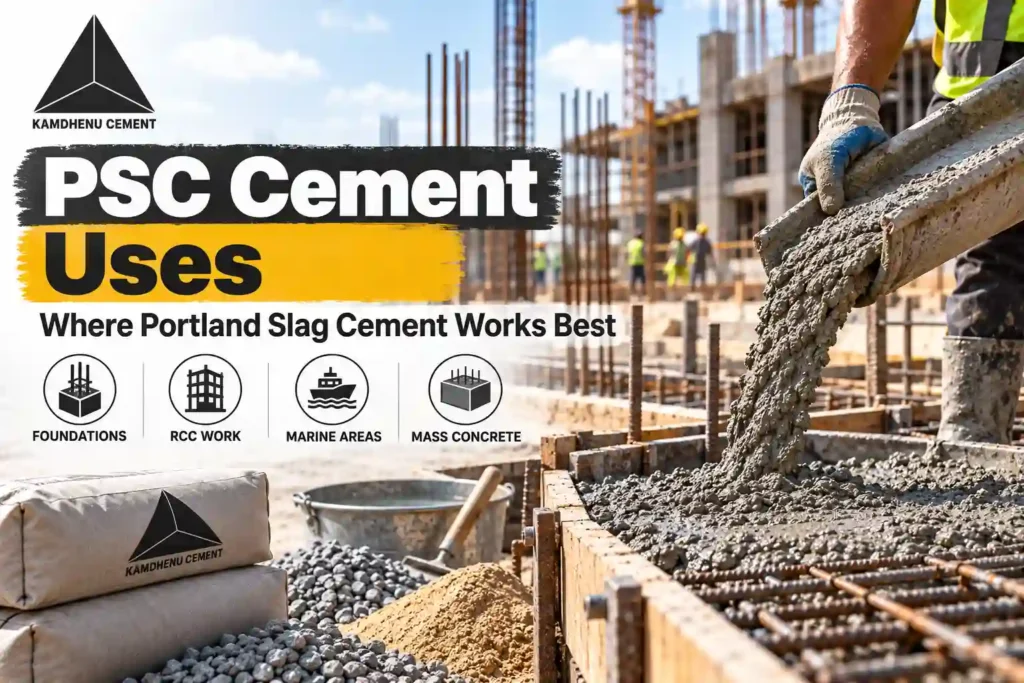
Not every construction application is the same, and not every cement grade is interchangeable. PSC cement uses are specific and well-defined — Portland Slag Cement performs better than Ordinary Portland Cement in a defined set of conditions, and understanding those conditions is what separates an appropriate specification from an uninformed one.
Portland Slag Cement is manufactured by blending OPC clinker with ground granulated blast furnace slag (GGBS) — a byproduct of the iron and steel industry that, when combined with cement, produces concrete with lower heat development, better long-term strength, and significantly improved resistance to sulphate and chloride attack. These are the core psc cement uses — foundations in aggressive soil, coastal construction, mass concrete, and industrial flooring. Kamdhenu Cement manufactures PSC grade cement meeting IS:455 specifications, available through their dealer network across India. This guide covers psc cement uses in detail — where it belongs and where it doesn’t.
What Is Portland Slag Cement Made Of?
Portland Slag Cement combines two main components:
OPC clinker — the primary reactive component, manufactured from limestone and other raw materials in a rotary kiln. The clinker provides the calcium silicate phases that drive initial strength development.
Ground granulated blast furnace slag (GGBS) — a by-product generated when molten pig iron is quenched rapidly with water or steam. The rapid quenching creates a glassy, granular material that is then ground to a fine powder. GGBS is a latent hydraulic binder — it reacts with water slowly on its own, but in the presence of calcium hydroxide (released during OPC hydration), it undergoes a pozzolanic reaction that contributes significantly to long-term strength and durability.
Under IS:455, the slag content in PSC must be between 25% and 65% by mass. The GGBS fraction replaces a portion of the clinker, which is what produces PSC cement’s characteristic lower heat development and enhanced chemical resistance.
Main Uses of PSC Cement
The main psc cement uses are concentrated in applications where low heat of hydration and high chemical resistance provide real value.
Marine construction — piers, jetties, seawalls, and harbour structures face continuous seawater exposure. Seawater contains chlorides and sulphates in concentrations that attack standard OPC concrete. The GGBS in PSC reduces both permeability and reactivity to these ions — making Portland Slag Cement the standard specification for marine construction in India.
Coastal infrastructure — buildings and structures within a few kilometres of the sea face salt air exposure that drives chloride penetration into concrete over time. Chloride attack corrodes reinforcement, causing the expansion and spalling that visibly degrades coastal concrete. PSC cement for coastal applications reduces this penetration rate significantly.
Mass concrete — foundations, raft slabs, and large concrete pours generate heat through the exothermic hydration reaction. In large volumes, this heat creates temperature differentials between the core and the surface that produce thermal cracking. The low heat of hydration of PSC cement reduces this thermal stress — which is why it’s specified for dam construction, thick retaining walls, and large pile caps.
Sulphate-exposed foundations — one of the most critical psc cement uses. Soils in parts of India contain elevated sulphates that weaken OPC concrete over time. PSC’s superior sulphate resistance makes it the appropriate choice wherever soil testing indicates medium to high sulphate content.
Industrial flooring — factory floors, warehouses, and industrial facilities exposed to chemical spillage, acidic cleaning agents, or moderate sulphate exposure benefit from PSC’s chemical resistance.
Key Benefits of PSC Cement
Better durability in aggressive environments. The pozzolanic reaction produces a denser concrete matrix with fewer interconnected pores. This reduces permeability — which is the primary route by which sulphates, chlorides, and moisture-borne chemicals attack concrete.
Low heat of hydration. PSC generates less heat per kilogram during hydration than OPC. For mass concrete pours, this reduces the risk of thermal cracking without requiring chilled water or other heat management measures.
Improved long-term strength. PSC concrete continues developing strength beyond the standard 28-day measurement window. At 90 days, PSC concrete often exceeds equivalent OPC concrete in compressive strength because the GGBS reaction continues to produce binding CSH phases over an extended period.
Sustainability. GGBS is an industrial by-product. Incorporating it into PSC reduces clinker content and CO₂ emissions per tonne — relevant for green building ratings.
PSC vs OPC Cement: What Is the Difference?
| Property | PSC | OPC |
| Main component | Clinker + GGBS (25–65% slag) | Clinker |
| Heat of hydration | Lower | Higher |
| Early strength | Slightly slower | Faster |
| Long-term strength | Equivalent to higher | Standard |
| Sulphate resistance | High | Moderate |
| Chloride resistance | Better | Standard |
| Permeability | Lower | Standard |
| IS code | IS:455 | IS:8112 / IS:12269 |
| Best applications | Marine, coastal, mass concrete, sulphate soils | General RCC, precast, plastering |
The PSC vs OPC cement distinction is not about better or worse — it’s about application match. OPC achieves higher early strength, which matters for structural work on accelerated schedules. PSC achieves better durability in aggressive environments, which matters for the long-term performance of exposed concrete.
Is PSC Cement Good for House Construction?
PSC cement for house construction is appropriate in specific contexts — not as a universal substitute for OPC.
Where PSC is the right choice for house construction:
- Foundations in coastal or sulphate-bearing soil areas
- Basements and below-grade construction in aggressive ground conditions
- Raft foundations and thick footing pours where heat of hydration is a concern
Where OPC or PPC is typically preferred:
- Structural RCC where fast early strength is required
- Plastering and masonry — PSC offers no advantage here
- Precast elements requiring high early strength
For standard residential construction in non-coastal, non-aggressive soil areas, OPC 43, OPC 53, or PPC are the primary grades. PSC becomes the specification when site conditions justify it.
PSC Cement Standards and Specifications
PSC in India is governed by IS:455 — the Indian Standard for Portland Slag Cement. Key requirements:
- Slag content: 25–65% by mass
- Minimum 28-day compressive strength: 33 MPa (the same as PPC)
- Initial setting time: not less than 30 minutes
- Final setting time: not more than 600 minutes
- Soundness: within defined limits
IS:456 permits PSC for all exposure conditions, specifically recognising its suitability for marine and sulphate-exposed environments. For aggressive exposure categories (Table 3), PSC is one of the recommended types.
When specifying PSC cement, verify the BIS licence number on the bag under IS:455 — uncertified slag blends don’t guarantee the slag content or performance parameters that make psc cement uses valid.
Conclusion
Psc cement uses are best understood by the environments the product is designed for: marine exposure, high sulphate soils, mass concrete, and coastal infrastructure. In these conditions, Portland Slag Cement’s lower permeability, better chemical resistance, and reduced heat of hydration produce concrete that outperforms OPC over the structure’s life.
Kamdhenu Cement manufactures PSC to IS:455 specifications. For product details and dealer locations in your state, visit kamdhenucement.com.
FAQs
What are the main uses of PSC cement?
PSC cement is commonly used in marine construction, coastal infrastructure, mass concrete, sulphate-exposed foundations, and industrial flooring because of its durability and chemical resistance.
What is the difference between PSC and OPC cement?
PSC contains ground granulated blast furnace slag (GGBS), offering lower heat of hydration and better sulphate and chloride resistance, while OPC generally develops early strength faster.
Is PSC cement good for house construction?
Yes, PSC cement is suitable for house foundations in coastal areas, sulphate-bearing soils, basements, and thick footings where durability or heat control is important.
What is the role of GGBS in Portland Slag Cement?
GGBS improves long-term strength and durability by reducing concrete permeability and increasing resistance to sulphate and chloride attack.
Which standard governs Portland Slag Cement in India?
Portland Slag Cement is governed by IS 455, which specifies requirements such as slag content, compressive strength, setting time, and soundness.