Concrete doesn’t harden through drying — it hardens through hydration, the chemical reaction between cement and water. Curing is the process of keeping that reaction going long enough for the concrete to reach its design strength. Stop the moisture too early, and you get a surface that looks set but has only achieved a fraction of its potential strength. The right concrete curing methods and duration make the difference between concrete that lasts decades and concrete that starts cracking within the first monsoon.
Most construction sites in India underestimate how many days curing of concrete actually requires. IS 456 — the Indian Standard code for concrete practice — specifies minimum curing periods by cement type and exposure condition. Kamdhenu Cement manufactures OPC and PPC grades specifically suited to Indian construction conditions; in both cases, the concrete can only perform to its rated strength if curing is done correctly. This guide covers the main concrete curing methods and the mistakes that reduce concrete to less than what the specification promised.
Common Concrete Curing Methods
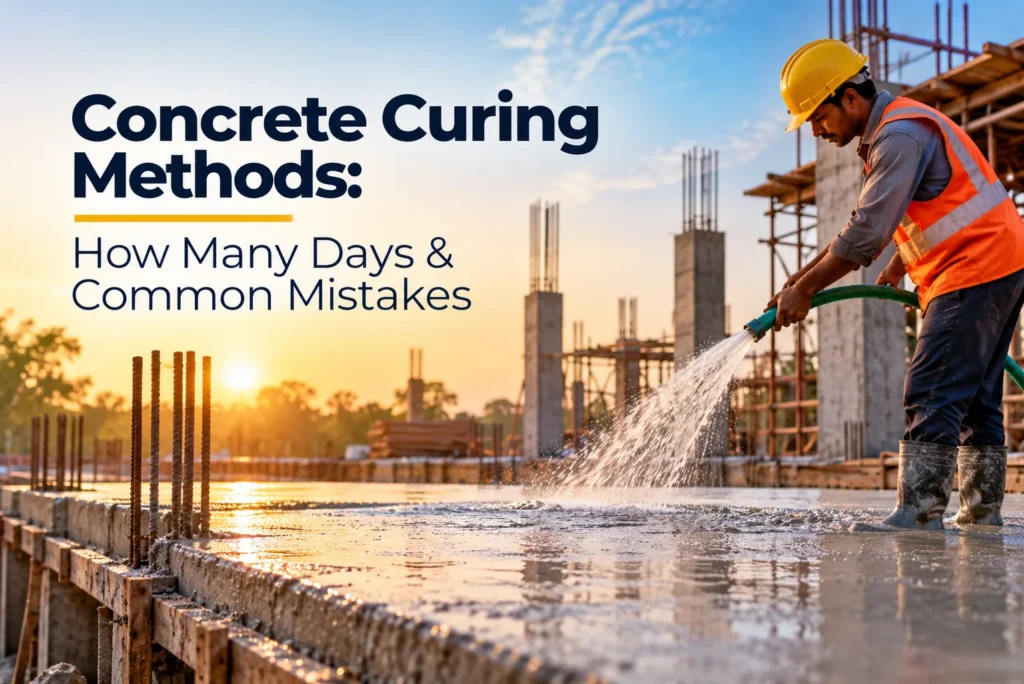
Water curing of concrete — the most effective and most widely used category of curing in India. Water keeps the concrete surface continuously moist, maintaining the humidity needed for cement hydration to proceed. Several techniques fall under this category:
Ponding method — small earthen bunds are formed around the concrete surface and filled with water, keeping the entire surface submerged. Highly effective for horizontal elements like slabs and floors. Labour-intensive to set up but requires minimal ongoing attention once in place.
Sprinkling — water is sprinkled over the concrete surface at regular intervals using a hose or sprinkler system. Practical for large areas. The gap between sprinkling cycles must be short enough that the surface doesn’t dry — 30 to 60 minutes in hot weather.
Wet hessian cloth — hessian or jute bags are wetted and placed over the concrete surface, then kept moist. One of the most practical concrete curing methods for vertical surfaces, slabs, and columns where ponding isn’t possible. The cloth holds moisture in contact with the surface between watering cycles.
Membrane curing — where water is not readily available or where continuous manpower for water curing isn’t practical, a curing compound is sprayed over the concrete surface immediately after finishing. The curing compound forms a film that retains moisture inside the concrete rather than adding water from outside. Performance depends on the compound quality and complete surface coverage — any gap breaks the membrane seal.
Steam curing — used in precast concrete manufacturing where rapid strength gain is needed. Not common in field construction. High-temperature steam accelerates hydration significantly, reaching higher early strength than ambient temperature water curing.
Formwork retention — for elements like columns and beams, keeping the formwork in place provides natural humidity retention. The formwork itself acts as a moisture barrier while the concrete gains strength.
How Many Days Should Concrete Be Cured?
The how many days curing of concrete question depends on the cement type and the structural element.
OPC (Ordinary Portland Cement): IS 456 specifies a minimum curing period of 7 days for OPC concrete in moderate exposure conditions. 7 day strength of OPC concrete reaches approximately 65–70% of the 28-day design strength. For aggressive exposure conditions — marine environment, chemical exposure — minimum curing is extended to 10–14 days.
PPC (Portland Pozzolana Cement): PPC develops strength more slowly than OPC due to the pozzolanic reaction. IS 456 specifies a minimum curing period of 10 days for PPC, and 14 days is often recommended in practice. 28 day strength remains the design standard for both cement types.
Curing time for slab: A roof slab or floor slab should be cured for a minimum of 7 days for OPC concrete, 10 days for PPC. In practice, 14 days produces a meaningfully stronger surface layer — the difference shows up in surface abrasion resistance and long-term durability.
High-performance concrete (M40 and above): Extended curing of 14–28 days is recommended. The high cement content and low water-cement ratio make hydration particularly sensitive to early drying.
The 28-day mark is when design strength is evaluated, but the hydration reaction continues beyond that — stopping curing at 7 days doesn’t mean hydration stops completely, it means it slows significantly. The first week is when controlled moisture matters most.
Water Curing of Concrete: Process and Benefits
Water curing of concrete is the IS 456-recommended primary method for most construction applications. The process:
Timing: Begin curing as soon as the concrete has set sufficiently to resist surface damage from water application — typically 6–12 hours after casting for slabs, earlier for covered surfaces.
Frequency: In summer conditions above 30°C, the surface must be kept continuously moist. Sprinkling every 2–3 hours or maintaining continuous ponding. In cooler weather, every 4–6 hours may be sufficient.
Coverage: Every exposed surface must be reached. Edges, corners, and underside of overhangs are where drying and cracking start first.
Benefits: Water curing ensures continuous hydration, prevents plastic shrinkage cracks from forming before the concrete has gained sufficient tensile strength, and produces the highest long-term strength gain of all curing approaches.
Common Concrete Curing Mistakes to Avoid
Starting too late. Concrete begins drying immediately after casting. In hot, dry, or windy conditions, plastic shrinkage cracks form on the surface within hours of casting if curing isn’t started promptly. Start curing within 6 hours of the final finish.
Stopping too early. The most common mistake in Indian residential construction. Curing is stopped after 2–3 days because the surface “looks set.” Setting and strength gain are different processes — the concrete may look solid while still being well below its 7-day strength.
Incomplete coverage. Gaps in hessian cloth coverage, missing a corner with the water spray, or allowing the curing compound to thin at edges all create zones where the concrete dries prematurely. The weakest area determines the overall floor performance.
Using the wrong method for the element type. The ponding method works on horizontal slabs — it doesn’t work on columns or walls. Match the concrete curing methods to the element geometry.
No curing at all for exposed slabs. Roof slabs left without curing in Indian summer conditions can lose significant moisture within 24 hours. Surface scaling, dusting, and early cracking are the result.
How to Choose the Right Concrete Curing Method
The decision depends on element type, water availability, site conditions, and temperature.
Horizontal slabs: Ponding method first choice, wet hessian as backup. Sprinkling acceptable where ponding isn’t practical.
Vertical elements (columns, walls): Wet hessian cloth wrapped and kept moist. Membrane curing as an alternative where wrapping isn’t practical.
Large pours in water-scarce sites: Membrane curing using a curing compound. Requires careful application — no gaps.
Hot and dry weather: Water curing is essential — membrane curing alone may not provide sufficient moisture retention in extreme conditions. Supplement with shading where possible.
PPC concrete: Add 3–7 days to whatever schedule you’d use for OPC. PPC’s slower strength development is a feature under normal curing — it’s a liability if curing is cut short.
For Kamdhenu OPC and PPC cement users, the manufacturer’s recommendation aligns with IS 456 — 7 days minimum for OPC, 10–14 days for PPC — with water curing as the primary method and membrane curing as the practical alternative where site conditions demand it. Visit kamdhenucement.com for technical guidance and dealer contacts.
Conclusion
Concrete curing methods determine whether the material you’ve specified actually performs to design. The chemistry requires moisture and time — the concrete curing methods you choose, the number of days you maintain them, and the consistency with which the surface is kept moist all feed into the final strength of what you’ve built.
How many days curing of concrete requires is not a negotiable minimum — it’s the period during which the investment in cement quality, mix design, and placement either delivers its potential or doesn’t.
FAQs
1. How many days should concrete be cured?
Concrete should generally be cured for at least 7 days with OPC and 10 days with PPC under normal conditions. Longer curing may be needed depending on exposure and site conditions.
2. What is the curing time for a concrete slab?
The minimum curing time for a slab is generally 7 days for OPC and 10 days for PPC. Extending curing to 14 days can improve durability.
3. Which concrete curing method is best?
Water curing of concrete is one of the most effective methods. Ponding works well for slabs, while wet hessian cloth is suitable for walls and columns.
4. Why is water curing of concrete important?
Water curing maintains moisture for cement hydration, helping concrete develop strength, reduce shrinkage cracking, and improve long-term durability.
5. What are the common mistakes in concrete curing?
Common mistakes include starting curing too late, stopping too early, missing surface areas, using unsuitable curing methods, and allowing concrete to dry in hot weather.