
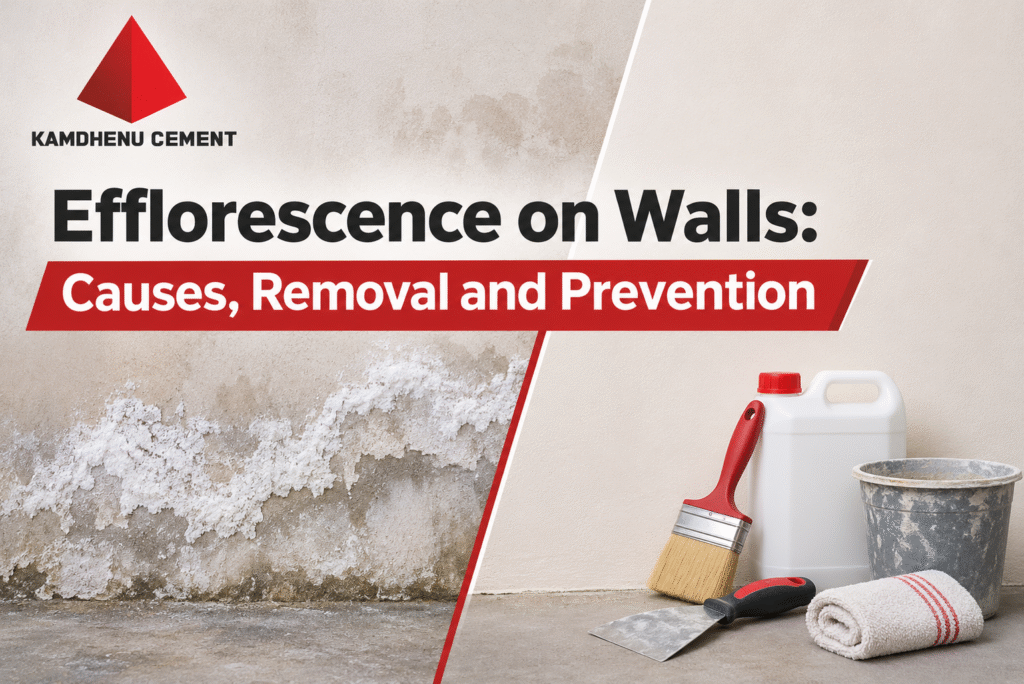
Efflorescence on walls shows up as a white, powdery or crusty deposit that appears on brickwork, plaster and concrete, usually a few months after construction or after the first heavy monsoon. Homeowners tend to treat it as a paint problem and repaint. A few weeks later the white patches on brick walls come back, because paint was never the cause.
The real issue is moisture carrying salt through the wall. Fix the moisture and the salts, and the patches stop. Skip that step and no coating will hold. Kamdhenu Cement manufactures BIS-certified OPC and PPC grades across 15 Indian states, and the cement and mortar used in a wall play a real part in how much moisture and salt it lets through. This guide covers what causes efflorescence, how to remove it, and how to stop it coming back.
What Is Efflorescence on Walls?
Efflorescence on walls is a deposit of salt left on a surface after water evaporates. Three things must be present for it to form: soluble salts in the wall material, water to dissolve them, and a path for that water to reach the surface and dry out.
The salts are mostly sulphates of sodium, potassium, calcium and magnesium, along with some carbonates. They come from bricks, sand, cement, water or the soil. Moisture dissolves them inside the wall and carries them outward. When the water evaporates at the surface, the salt crystals stay behind.
The white patches on brick walls are most visible after rain and in winter, when slow evaporation lets more salt settle. These salt deposits on walls are usually cosmetic on their own, but they are a clear signal that water is moving through your wall.
Common Causes of Efflorescence
Efflorescence on walls has one root cause, water carrying salts, but the sources vary.
Poor brick quality. Bricks made from salty clay or fired at low temperature carry high levels of soluble salts. Brick quality is the most common single source of salt deposits on walls. Bricks can be tested for efflorescence, and buyers can ask for a rating of nil or slight.
Contaminated sand or water. Sea sand, unwashed river sand and brackish construction water add salts directly into the mortar and plaster.
Moisture ingress. Roof leaks, bad terrace drainage, leaking pipes, cracked plaster and exposed parapets let water into the wall. Rising damp does the same from below when there is no damp proof course.
Capillary action. Brick and mortar are porous. Water is pulled upward through the tiny pores in the same way a wick draws oil. Without a barrier at the plinth, ground moisture climbs the wall and brings salts with it.
Excess water in the mix. Too much water makes mortar and plaster more porous and increases the pathways moisture can use. Poor curing makes it worse, because the cement never fully densifies.
Low-grade cement and poor mix. A weak or badly proportioned mortar is more permeable. Good, consistent cement used at the correct ratio gives a denser matrix that lets less water through.
How to Remove Efflorescence From Walls
How to remove efflorescence depends on how bad it is, but the order is the same: let the wall dry, remove the salt, then deal with the cause.
Step 1: Dry brushing. Fresh, light deposits are removed with wire brush cleaning or a stiff bristle brush. Keep the wall dry, because water at this stage simply dissolves the salt and pulls it back in. Collect the dust and dispose of it.
Step 2: Clean with water. For stubborn patches, scrub with a stiff brush and clean water, then wipe dry. Use minimal water.
Step 3: Diluted acid wash. For heavy or old deposits, a diluted acid wash is the usual method. A commonly cited mix is around one part hydrochloric acid to ten parts water, but always test a small area first. Wet the wall beforehand, apply the solution, scrub, then rinse thoroughly with clean water. Wear gloves, goggles and a mask, and do not use acid on coloured, polished or stone surfaces, because it can damage them.
Step 4: Let it dry completely. Wait until the wall is fully dry before sealing or painting. White patches on brick walls that return after a few weeks mean the moisture source is still active.
Removing efflorescence on walls without stopping the moisture only buys time. The next steps matter more than the cleaning.
How to Prevent Efflorescence on Walls
Install a damp proof course. A proper damp proof course at plinth level stops ground moisture from climbing the wall by capillary action.
Choose good bricks. Ask for bricks with low soluble salt content and a nil or slight efflorescence rating. Cheap, underfired bricks are the usual problem.
Use clean sand and water. Washed sand and potable water keep salt out of the mortar and plaster, so salt deposits on walls have less to form from.
Control the mix and cure properly. Use the right cement-sand ratio, avoid extra water, and keep plaster and masonry moist for at least seven days. BIS-certified cement used correctly gives denser, less permeable work.
Seal the water entry points. Fix roof and terrace waterproofing, parapet joints, gutters, leaking pipes and cracks. Stopping moisture ingress at the source is the single most effective prevention.
Apply a water repellent coating. Once the wall is dry and clean, a breathable water repellent coating helps keep rain out while letting moisture vapour escape. A non-breathable paint can trap moisture and make the problem worse.
Risks of Ignoring Efflorescence
Efflorescence on walls isn’t structurally dangerous on its own. The risks come from what it signals and what continues underneath.
Paint and plaster damage. Salt crystallising behind paint pushes it off in flakes. Inside the plaster, repeated crystallisation breaks the surface, leading to plaster damage, powdering and hollow patches.
Sulphate attack. Sulphates in a damp wall can react with cement compounds and cause expansion, cracking and weakening of the mortar over time.
Hidden dampness. If moisture is moving through the wall, mould, musty smells and peeling interior finishes usually follow.
Reinforcement corrosion. In RCC elements that stay damp, salts can speed up corrosion of the steel inside, which leads to cracks and spalling.
Repeated repair cost. Repainting without fixing the cause turns a one-time repair into a recurring one.
Conclusion
Efflorescence on walls is a moisture problem that leaves a salt signature. Brush off the deposit, wash if needed, but spend your effort on the cause: damp proofing, good bricks, clean materials, proper curing and sealed water entry points.
For a wall that stays clean, start with consistent materials. Kamdhenu Cement’s BIS-certified OPC and PPC grades are available across 15 Indian states. Visit kamdhenucement.com for product details and dealer contacts.
FAQs
What causes efflorescence on walls?
Efflorescence forms when moisture carries soluble salts through bricks, mortar or concrete and leaves white deposits as the water evaporates.
How do I remove efflorescence from walls?
Start with dry brushing. For stubborn deposits, use minimal clean water or a suitable diluted acid wash with proper safety precautions.
How can I remove white patches on brick walls permanently?
Remove the salt deposits and fix the moisture source, such as leaks, rising damp, poor drainage or cracks. Otherwise, the patches may return.
Are salt deposits on walls harmful?
They are usually cosmetic, but can indicate moisture problems that cause peeling paint, plaster damage, mould and, in some cases, corrosion.
How can I prevent efflorescence on walls?
Use low-salt bricks, clean sand and water, properly mixed mortar, a damp proof course, and effective waterproofing to control moisture.