
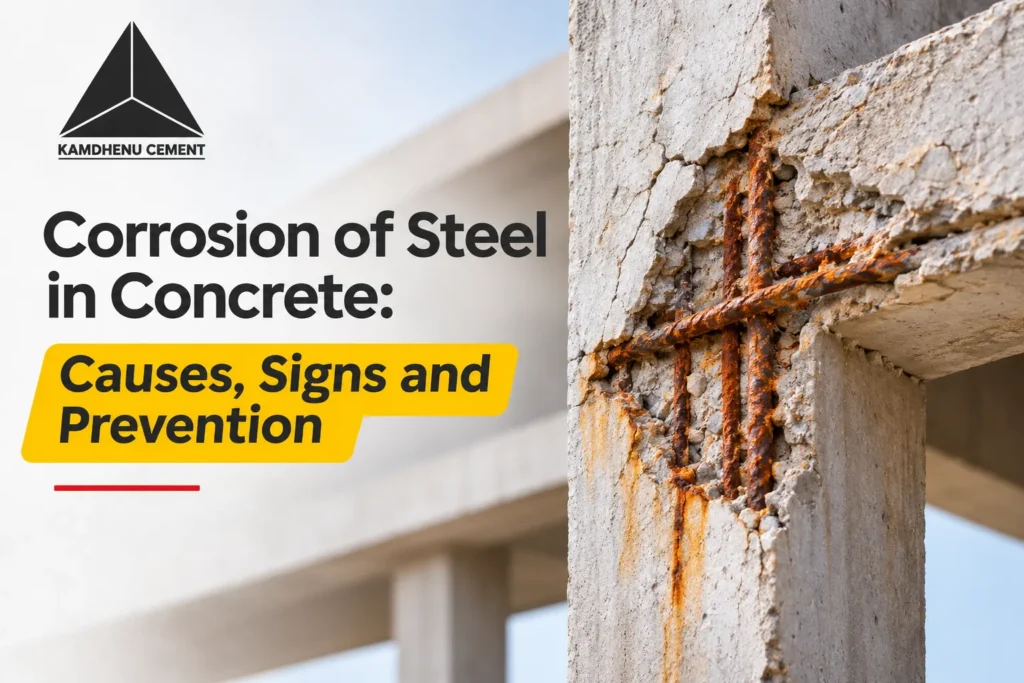
The first sign is usually a brown stain running down a column or the underside of a balcony slab. A few months later a piece of concrete drops away and there’s a rusted bar behind it. By then the damage has been going on for years. Corrosion of steel in concrete is rarely sudden. It starts inside the structure, driven by carbonation or chloride ingress, long before anything shows on the surface.
Kamdhenu Cement supplies OPC and PPC across northern and central India, and cement quality is the first line of defence here. A dense, well-cured concrete keeps air and moisture away from the steel. This guide covers why steel rusts in RCC, how to spot it early, and how to prevent it.
What Is Corrosion of Steel in Concrete?
Steel inside healthy concrete is protected. Concrete is highly alkaline, with a pH around 12.5, and that alkalinity forms a thin passive film on the steel that stops it from rusting. Corrosion of steel in concrete begins when this film breaks down. After that, oxygen and moisture do the rest.
The real problem is volume. Rust takes up several times more space than the steel it came from. That expansion pushes outward against the surrounding concrete until it cracks and breaks away.
Common Causes of Steel Corrosion in Concrete
Most cases of corrosion of steel in concrete trace back to one of the causes below, and often to more than one working together.
Carbonation. Carbon dioxide from the air slowly reacts with the concrete and lowers its pH. Once carbonation reaches the steel, the protective film is lost. Porous, poorly cured concrete carbonates faster.
Chloride ingress. Chlorides from coastal air, salty groundwater, or contaminated aggregates and mixing water break down the film even when the concrete is still alkaline. This is common in coastal cities and wherever sea sand has been used.
Inadequate cover. Concrete cover for reinforcement is the physical barrier between steel and the outside world. IS 456 sets nominal cover by exposure: 20 mm for mild, 30 mm for moderate, 45 mm for severe, 50 mm for very severe, and 75 mm for extreme conditions. On site, cover blocks slip and bars sag, and a specified 40 mm cover quietly becomes 15 mm.
High water cement ratio. Extra water makes concrete more porous, which lets moisture and air reach the steel faster. IS 456 caps the water cement ratio at 0.55 for mild exposure and tightens it to 0.40 for extreme exposure.
Poor compaction and curing. Honeycombing and early surface cracks give water a direct route to the bars.
Leakage. Leaking bathrooms, terraces, and plumbing keep concrete wet for years, which is all corrosion needs.
Signs of Rusting of Rebar in RCC
Corrosion of steel in concrete gives visible warning before it becomes dangerous, if you know what to look for.
Rust stains. Brown or orange streaks on the surface, often following the line of a bar underneath.
Cracks along the bars. Rusting of rebar in RCC produces cracks that run along the steel, such as vertical cracks in columns or lines along beam soffits. Cracks in columns deserve more urgency than slab cracks, because columns carry the load of everything above. Any crack following a column bar should be checked by a structural engineer.
Spalling of concrete. The cover breaks away in patches and exposes the bars. Tapping the surface with a hammer gives a hollow sound where the concrete has already separated from the steel behind it.
Flaking, reduced bars. Where the cover has gone, exposed bars often show layers of scale and visibly thinner sections.
These signs usually appear in order: stains first, then cracks, then spalling. Acting at the stain stage means a small patch repair. Acting at the spalling stage means structural repair.
How to Prevent Corrosion of Steel in Concrete
Get the cover right. Concrete cover for reinforcement depends on proper cover blocks, cast from cement mortar and spaced as the drawing requires, not brick pieces or wooden scraps. IS 456 also asks for at least 40 mm cover to column bars and more than 50 mm in footings. Check the clear cover before the pour, because it can’t be fixed after.
Keep the water cement ratio low. Specify the mix design for the exposure condition and don’t let extra water be added at site to make placing easier.
Compact and cure properly. Vibrate thoroughly to avoid honeycombing, and cure for the full period. Curing matters more for PPC, whose pozzolanic reaction gives a denser, less permeable concrete over time, but only if it stays moist long enough to develop.
Choose clean materials. Use clean mixing water and washed aggregates, and avoid sea sand.
Use the right steel. TMT bars to IS 1786, free from loose scale and pitting, are the baseline. For coastal or aggressive environments, epoxy coated bars or corrosion-resistant grades add protection, though coated bars must be handled carefully and any damaged coating repaired.
Consider a corrosion inhibitor. In severe exposure, a corrosion inhibitor admixture in the mix gives extra protection to the steel.
Waterproof and drain. Waterproof terraces and wet areas, and fix leaks early. Seal cracks before water finds them.
Effects of Corrosion on RCC Structures
The effects of corrosion of steel in concrete build in stages, and each stage makes the next one faster.
Loss of steel section. As the bar corrodes, its cross-section shrinks and so does its load capacity.
Loss of bond. Rust weakens the grip between steel and concrete, so the two stop working as one.
Cracking and spalling. Cracks and spalling of concrete let in more water and air, which speeds up the corrosion that caused them.
Safety risk. In columns and beams, advanced corrosion can reduce capacity enough to threaten the structure.
Repair cost. Structural repair is far more expensive than prevention. A typical repair involves removing loose concrete, cleaning the bars to bare metal, applying an anti-corrosive coating, restoring the section with repair mortar, and finishing with a protective coat. Badly corroded bars may need replacing, as the engineer directs.
Conclusion
Corrosion of steel in concrete is a slow process with a long warning period, and most of the defences are decided before the pour: proper cover, a low water cement ratio, good compaction, full curing, and sound materials. Catching rust stains and early cracks, and acting on them, costs far less than waiting for spalling.
For OPC and PPC supply for new construction, visit kamdhenucement.com or contact your nearest Kamdhenu dealer.
FAQs
1. What causes corrosion of steel in concrete?
The main causes include carbonation, chloride ingress, inadequate concrete cover, high water-cement ratio, poor curing, and continuous moisture exposure.
2. How can I prevent rusting of rebar in RCC?
Use adequate concrete cover, maintain a low water-cement ratio, compact and cure concrete properly, and prevent water leakage.
3. What is the recommended concrete cover for reinforcement?
As per IS 456, nominal cover ranges from 20 mm for mild exposure to 75 mm for extreme exposure conditions.
4. What are the early signs of corrosion in RCC structures?
Early signs include brown rust stains, cracks along reinforcement bars, hollow-sounding concrete, and exposed or flaking steel.
5. What causes spalling of concrete around reinforcement?
Rust expands as steel corrodes, creating internal pressure that causes surrounding concrete to crack and break away.